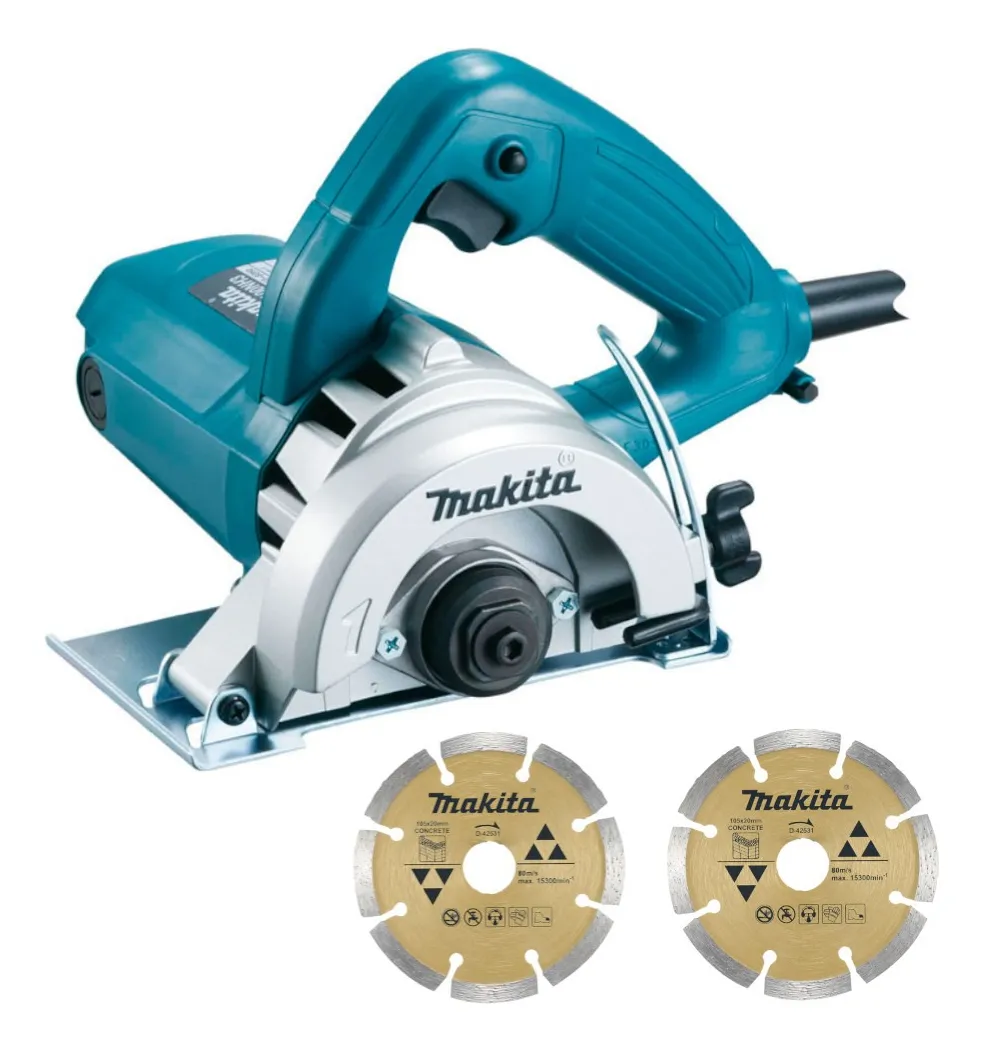
A compact electric marble saw made for masonry, tile, stone and renovation work, with a 1300W motor, 110 mm disc capacity and a practical kit that includes two discs.
The Makita 4100NH3ZX2 is worth considering if you need a compact, professional-style marble saw for construction, renovation, tile work, masonry cuts and stone-related jobs. Its main appeal is the combination of 1300W power, 13,800 rpm rotation, 32 mm maximum cutting depth, 110 mm disc size and a manageable 2.9 kg body. It makes the most sense for users who want a reliable corded cutter rather than a very basic occasional-use tool.
The Makita 4100NH3ZX2 review starts with a simple buying question: do you need a marble saw that is compact enough for daily handling but strong enough for demanding cutting tasks? This model sits in that practical middle ground, where portability, cutting speed and brand reliability matter more than unnecessary extras.
It is not the right tool for every buyer. If you need deep structural cuts, battery freedom or a larger disc platform, another model may suit you better. But for ceramic, masonry, marble, granite, tile and similar material work with the correct disc, this Makita is a very convincing option.
What the Makita 4100NH3ZX2 is made to do
The Makita 4100NH3ZX2 is a corded electric marble saw designed for cutting hard construction and finishing materials. It uses a 110 mm disc, runs at 13,800 rpm and has a maximum cutting depth of 32 mm. That makes it suitable for many common jobs in renovation, finishing, masonry, tile installation and stone work.
Its 1300W motor is one of the strongest reasons to look at this model. A marble saw is often judged not only by its maximum depth, but by how confidently it maintains cutting performance through dense material. In this case, the motor gives the tool enough force for regular jobsite use, provided the disc is appropriate for the material.
The body weight of 2.9 kg keeps the tool relatively manageable. That matters because marble saws are often used in awkward positions, repetitive cuts and finishing adjustments. A tool that is too heavy can quickly become tiring, especially for installers, contractors, builders and renovation workers who use it several times during the day.
The product also comes with a wrench, an Allen key and two discs. That is useful because it gives the buyer a more complete starting kit, although the best cutting performance will still depend on matching the right disc to the material being cut.
The disc size and cut depth decision many buyers get wrong
The key point with this Makita marble saw is the 110 mm disc and 32 mm maximum cutting depth. This combination is excellent for many finishing and construction cuts, but it should not be confused with the capacity of larger saws. If your work involves thicker slabs or deeper structural cutting, the 4100NH3ZX2 may not be the most efficient choice.
For common tile, ceramic, masonry and stone-related tasks, the depth is usually practical. It gives enough reach for many renovation cuts without making the machine oversized. That balance is one of the reasons compact marble saws remain popular among professionals and serious DIY users.
The mistake is buying only by motor power and ignoring the disc platform. A 1300W motor is strong, but the maximum depth still follows the 110 mm disc format. This is a compact cutter, not a large cutting machine for heavy demolition or deep concrete work.
Before choosing this model, the buyer should think about the materials, thicknesses and cutting frequency involved. If the job is mostly tile, ceramic, marble, granite pieces, masonry channels and finishing cuts, the format makes sense. If the work requires frequent deep passes, a larger disc model may save time and effort.
Where the 1300W motor helps in daily work
The 1300W motor gives the Makita 4100NH3ZX2 a strong advantage over weaker entry-level cutters. The benefit is not only speed. A stronger motor can make the tool feel more stable when cutting harder material, especially when the user keeps a controlled pace and avoids forcing the blade.
For professionals, this matters because clean work is often about consistency. A cut that starts well but loses rhythm halfway through can damage material, slow the job and increase fatigue. The high rotation speed of 13,800 rpm supports fast cutting action, while the motor gives the saw enough energy for demanding surfaces.
This does not mean the tool should be pushed aggressively. Marble saws perform best when the operator lets the disc work at the right pace. Excessive pressure can reduce precision, increase wear and make the cut less controlled. The Makita 4100NH3ZX2 rewards steady handling more than brute force.
Another practical advantage is the compact body. Power is useful, but only when the tool remains easy to control. A cutter with good output and manageable weight is more comfortable for repetitive work, especially when cutting floor pieces, wall tiles, stone strips or masonry sections.
What deserves attention before choosing this model
The first point to check is voltage. This model can appear in different voltage options, so the buyer should choose the correct one for the place where the tool will be used. A wrong voltage choice can make the purchase unusable or unsafe.
The second point is the type of disc. The machine accepts a 110 mm disc with 20 mm bore and up to 2 mm thickness, but the right disc depends on the material. Ceramic, porcelain, marble, granite, masonry, concrete, wood, metal and other materials demand proper accessories and safe technique. The tool is capable, but the disc selection decides the final cut quality.
The third point is cutting depth. A 32 mm maximum depth is practical, but it is not unlimited. Users who regularly cut thick stone pieces, heavy concrete sections or deeper construction elements should compare this format with larger marble saws before deciding.
Dust is another practical factor. Cutting masonry, stone, ceramic and similar materials can generate a lot of dust and debris. Proper protection, ventilation and work preparation are essential. The tool is compact, but the work environment still needs to be treated seriously.
How the included accessories improve the starting experience
The Makita 4100NH3ZX2 includes a wrench, an Allen key and two discs. For a buyer who wants to start using the tool without assembling a separate accessory kit immediately, that is a practical advantage. It also makes the product feel more complete out of the box.
The included tools help with disc changes and basic handling. This is especially useful for users who move between materials or need to replace accessories during a job. However, the included discs should not be treated as a universal solution for every material.
For best results, the buyer should still match the disc to the surface. A disc that performs well in one material may not deliver the same finish in another. This is especially important for visible tile cuts, porcelain, natural stone and finishing work where edge quality matters.
The presence of two discs is useful, but the real strength of this product is the machine itself. The motor, rotation speed, compact format and cutting depth are what make the Makita 4100NH3ZX2 stand out in practical use.
Technical profile and cutting behavior
The Makita 4100NH3ZX2 has 1300W of power, 13,800 rpm rotation, 110 mm disc diameter, 20 mm bore diameter, 2 mm maximum disc thickness and 32 mm maximum cutting capacity. The tool weighs 2.9 kg and uses electric power, making it a corded option for users who prefer steady performance over battery mobility.
In practice, this technical profile points to a compact but capable cutter. The high rpm helps with cutting speed, while the 1300W motor gives the tool enough strength for dense surfaces. The 2.9 kg weight keeps handling reasonable for repetitive cutting.
The double insulation is another relevant feature because it adds an extra layer of electrical protection in the tool design. That does not replace safe work habits, but it is a positive characteristic in a corded tool intended for construction and renovation environments.
The model also has a compact design, which helps when the user needs more control. In tight spaces, smaller cutting tools are often easier to guide than larger machines. That is especially useful for finishing cuts, adjustments and jobs where the user needs to see and control the cutting line carefully.
The buyer who will get the best result from it
This Makita marble saw makes the most sense for construction workers, contractors, tile installers, renovation professionals, masons, stone workers and serious DIY users. It is a good match for people who need a tool that can handle regular cutting tasks without moving into a bulky professional machine category.
It is also a strong option for buyers who prefer a known tool brand and want a compact electric cutter with practical specifications. The 1300W motor, high rotation speed and 32 mm depth make it useful for many jobs around ceramic, masonry, tile, marble and granite work.
For a home user, it may be more machine than necessary if the use is very occasional. But if the buyer is planning renovations, tile installation, outdoor finishing, masonry adjustments or repeated stone-related cuts, the 4100NH3ZX2 has enough capability to justify choosing a stronger model.
It also suits users who care about handling comfort. A lighter and more compact saw can reduce fatigue, especially during repetitive cuts. That becomes important when the work involves many pieces rather than one isolated cut.
When a different cutter may make more sense
This model is not the best match for someone who needs battery operation. Because it is corded, it depends on access to electricity. That can be an advantage for stable performance, but it may frustrate users who work in places without easy power access.
It may also be less suitable for users who need deeper cuts on a regular basis. The 32 mm maximum cutting depth is good for many tasks, but larger disc models provide more reach. If cutting depth is the main priority, comparing larger marble saws is the smarter route.
Another situation where it may not be ideal is extremely light occasional use. If the buyer only needs to make a few simple cuts and does not expect frequent work, a simpler tool may be enough. The Makita 4100NH3ZX2 is more attractive when durability, handling and consistent performance matter.
It can also frustrate users who expect one included disc to solve every material. This is not how cutting tools work. The machine is the base; the disc and technique complete the result. Buying the right accessories remains part of the decision.
How it compares with smaller, larger and more basic alternatives
Compared with weaker entry-level cutters, the Makita 4100NH3ZX2 offers a more confident technical package. The 1300W motor and 13,800 rpm rotation make it better suited for demanding materials and repeated work. This is the kind of difference that becomes visible when the tool is used often, not just once.
Compared with larger marble saws, its advantage is handling. A bigger tool can cut deeper, but it can also be heavier and less convenient for finishing tasks. The 4100NH3ZX2 is more appealing when the buyer wants control, portability and enough depth for common jobsite cutting.
Compared with cordless alternatives, the main difference is work style. Cordless tools offer mobility, but corded models usually appeal to users who want continuous operation without managing batteries. For workshop, renovation and construction environments with available electricity, a corded cutter can be very practical.
Compared with more premium or specialized cutting systems, this Makita keeps a straightforward approach. It is not trying to replace large wet saws, tile cutting stations or heavy-duty concrete cutters. Its strength is being a compact, powerful and versatile hand-held marble saw for real construction and finishing use.
The practical buying call on the Makita 4100NH3ZX2
The Makita 4100NH3ZX2 is a strong choice if your priority is a compact 1300W marble saw with good cutting speed, manageable weight and practical depth for common construction and finishing tasks. It is especially convincing for buyers who need a tool for tile, masonry, stone, marble, granite and renovation work with the correct disc.
Its best qualities are clear: strong motor, high rpm, 32 mm cutting capacity, 110 mm disc format, compact handling and useful included accessories. These are not decorative specifications. They directly affect how practical the tool feels during repeated work.
The main caution is also clear. This is not a deep-cutting machine and not a cordless tool. The buyer should choose it for controlled cuts, finishing work and regular construction use, not for every heavy cutting situation.
If that matches your work profile, the Makita 4100NH3ZX2 is easy to recommend. It offers a good balance between strength, portability and reliability, which is exactly what many buyers need from a marble saw in this category.
Is the Makita 4100NH3ZX2 good for tile and ceramic cutting?
Yes, the Makita 4100NH3ZX2 can be a good choice for tile and ceramic cutting when used with the correct disc. Its 110 mm disc format, 13,800 rpm speed and compact body help with controlled cuts. For visible finishing work, disc quality and steady handling are especially important.
Can the Makita 4100NH3ZX2 cut marble and granite?
Yes, the Makita 4100NH3ZX2 is designed for marble and stone-related cutting tasks, including materials such as marble and granite with the proper disc. The 1300W motor gives it enough strength for demanding surfaces, but the user should respect the 32 mm maximum cutting depth and avoid forcing the machine.
What is the maximum cutting depth of the Makita 4100NH3ZX2?
The maximum cutting depth is 32 mm. That is suitable for many construction, masonry, tile and finishing tasks, but it is not the same as a larger disc saw. If your work often involves thicker pieces or deep structural cuts, a larger cutting platform may be more appropriate.
Is this marble saw suitable for professional use?
Yes, it suits professional-style use in construction, renovation, masonry, marmoraria and tile installation when the job matches its size and cutting depth. Its 1300W motor, high rotation speed and compact handling make it more capable than many very basic cutters, especially for repeated tasks.
Does the Makita 4100NH3ZX2 come with accessories?
Yes, the kit includes a wrench, an Allen key and two discs. This makes the starting setup more convenient, especially for users who want a ready-to-use package. Even so, the buyer should select the right disc for each material to get cleaner, safer and more efficient cuts.
Is the 110 mm disc size enough for renovation work?
Yes, the 110 mm disc size is enough for many renovation jobs involving tile, ceramic, masonry, marble and similar materials. The important point is depth. The tool reaches up to 32 mm, which is practical for common cuts but not ideal for frequent deep cutting.
What should I check before choosing this model?
Check the voltage, disc compatibility and the thickness of the materials you plan to cut. The model uses a 110 mm disc with 20 mm bore and supports up to 32 mm cutting depth. If those details match your work, it becomes a much safer buying decision.
Is a corded marble saw better than a cordless one?
It depends on the work environment. A corded marble saw like the Makita 4100NH3ZX2 is better for users who want continuous electric operation and do not want to manage batteries. A cordless model is better when mobility matters more than uninterrupted power access.
The Makita 4100NH3ZX2 is a smart choice for buyers who want a compact, strong and practical marble saw for real cutting work. It delivers the essentials that matter most in this category: a 1300W motor, high rotation speed, 32 mm cutting depth, manageable weight and a complete basic accessory package.
It is best for users who understand the role of disc selection and do not expect one compact saw to replace larger cutting machines. For tile, masonry, stone, marble, granite and renovation use within its cutting capacity, it offers a dependable and well-balanced buying option.