A compact corded impact drill for wood, metal, concrete and masonry jobs where control, low weight and everyday practicality matter more than maximum power.
The Bosch GSB 450 RE is a good choice if you want a light, compact and reliable corded impact drill for home repairs, installations, maintenance work and moderate drilling tasks. It makes sense for users who need impact drilling, reverse rotation and variable speed in a simple tool. It is not the best pick for heavy structural drilling, large holes in hard concrete or users who expect cordless mobility.
The Bosch GSB 450 RE review starts with a simple point: this is not a drill made to replace a heavy rotary hammer, and it is not trying to be a premium cordless system. Its strongest appeal is the balance between compact size, corded consistency and enough impact function for common drilling tasks.
For many buyers, that balance is exactly what matters. A lighter drill is easier to control above shoulder height, inside cabinets, near corners and during repeated small jobs. The key is understanding what this Bosch drill does well before expecting it to perform like a larger professional machine.
What the Bosch GSB 450 RE is designed to handle
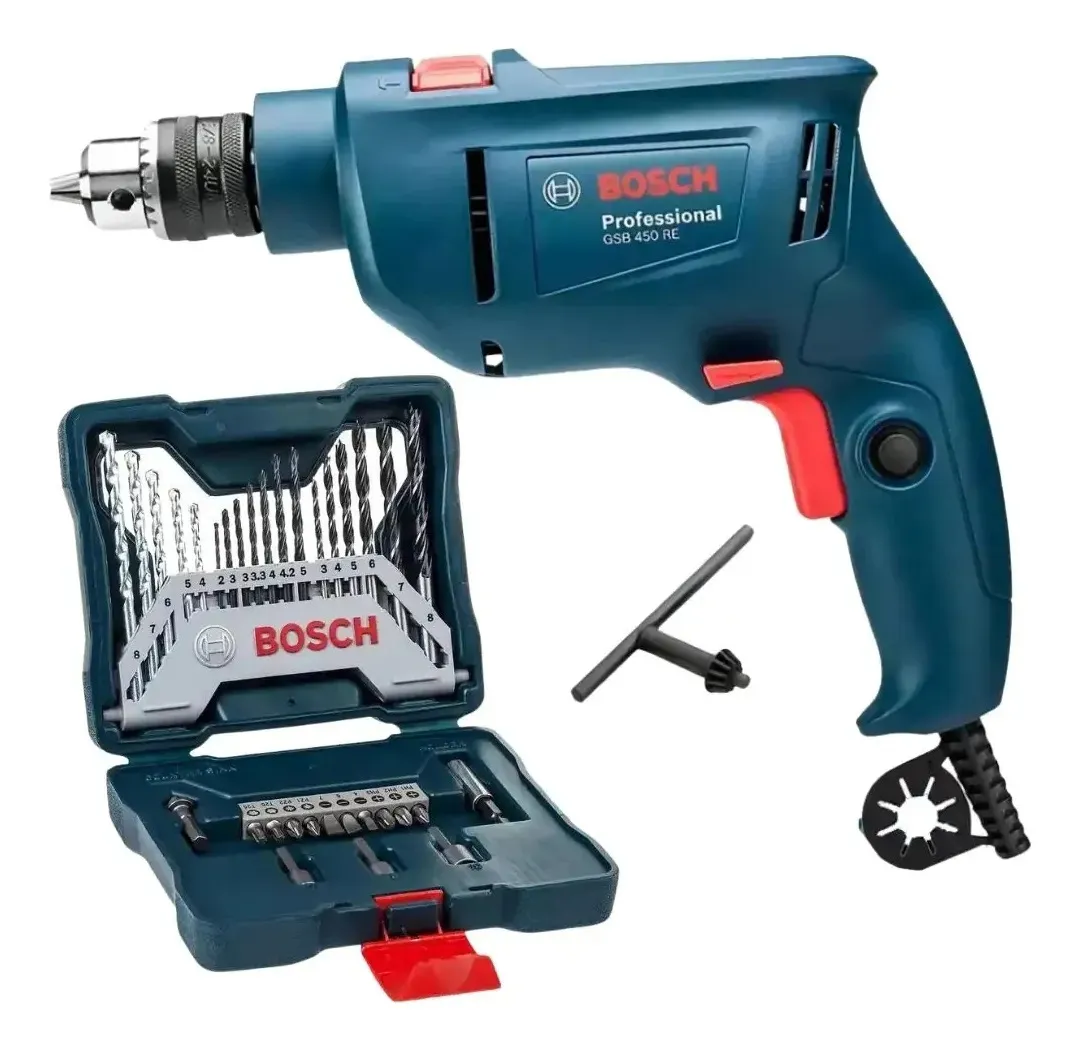
The Bosch GSB 450 RE is a corded impact drill from the Bosch Professional line. It uses a 450W motor and is built for drilling in wood, steel, concrete and masonry within compact-drill capacity. It also has reverse rotation, which helps when removing bits, backing out screws or correcting a jammed drilling position.
Its main value is versatility for everyday work. You can use it with impact mode for masonry and concrete within its capacity, or without impact for cleaner drilling in wood and metal. That makes it more flexible than a simple rotary drill and more familiar for users who do not want to manage batteries.
The tool is also compact and relatively light. This matters more than many buyers expect. When drilling overhead, working on a ladder or making several holes in a row, a lighter body reduces fatigue and gives better wrist control.
Because it is corded, it is best for people who usually work near a power outlet or can use an extension safely. It is not the ideal solution for jobs where movement across a large site is constant, but it avoids the downtime and battery management of cordless drills.
The common buying mistake with compact impact drills
The biggest mistake is reading “impact drill” and expecting rotary hammer behavior. The Bosch GSB 450 RE can drill into concrete and masonry, but it is still a compact impact drill, not an SDS hammer drill for aggressive construction work.
That distinction changes the buying decision. For wall plugs, light masonry holes, furniture installation, shelves, brackets and routine maintenance, this model fits the job well. For thick concrete slabs, large-diameter holes, frequent drilling into reinforced concrete or demolition-style work, a more powerful hammer drill is the safer choice.
Another mistake is ignoring the chuck size and drilling capacity. This drill uses a 10 mm chuck range, which is suitable for common household and maintenance bits. It is not built for very large accessories or high-load drilling where a bigger chuck, stronger motor and heavier gear system would be more appropriate.
The word “industrial” may appear in product listings, but it should be read carefully. The Bosch Professional branding and solid technical profile are positive signs, but this is still a compact 450W model. It is professional in construction and practical use, not a substitute for high-power industrial drilling equipment.
Where the 450W motor makes sense in real use
The 450W motor is enough for light to moderate drilling when the bit is appropriate and the user does not force the tool. It is especially suitable for installing curtain rods, shelves, cable channels, small fixtures, furniture hardware and general repair work.
In wood, the drill works well for common holes and assembly tasks. The lighter body helps when precision matters, especially when starting holes or working on thinner material. In steel, it makes sense for smaller holes with the correct bit and controlled pressure.
In concrete and masonry, the impact mode is the feature that gives the tool its practical value. It helps the bit break into harder surfaces more efficiently than normal rotation. Still, the best experience comes from matching the bit size to the tool’s capacity and avoiding excessive pressure.
The variable speed behavior also helps with control. Starting slowly reduces slipping on smooth surfaces, while higher speed can be used once the bit is stable. This is useful for beginners and for anyone working in visible areas where a misplaced hole would be a problem.
Practical strengths that matter during everyday work
The first strength is weight. At around 1.2 kg, the Bosch GSB 450 RE is easy to hold for longer periods than many heavier corded drills. That does not only improve comfort; it also improves accuracy because the user can keep the tool steady without fighting the body weight.
The second strength is compact handling. A smaller drill is easier to use in tighter spaces, near walls, above the head and inside furniture installations. For home maintenance and installation work, this can be more useful than simply having a larger motor.
The third strength is the reverse function. Reverse rotation is practical when removing a bit from a tight hole, correcting positioning or backing out fasteners. Even if the model is not primarily a screwdriver, reverse rotation adds flexibility in real maintenance tasks.
The fourth strength is corded continuity. Users who work intermittently at home or in a small workshop do not need to worry about battery health, charging time or battery replacement. As long as the voltage version matches the local electrical supply, the tool is ready whenever needed.
Another useful point is the lock-on button for continuous work. For repetitive drilling, this can reduce finger fatigue and make longer sessions easier. It should still be used with care, especially when drilling tougher materials where bit binding can happen.
Trade-offs to check before choosing this model
The most important trade-off is power. The Bosch GSB 450 RE is not weak for its size, but it is not intended for demanding structural drilling. Buyers who frequently work on hard concrete, thick masonry or larger holes should look at stronger corded drills or rotary hammers.
The second trade-off is mobility. Because it is corded, it depends on access to electricity. That is fine in a garage, apartment, small workshop or controlled job site. It is less convenient when working outdoors, moving between rooms constantly or operating where outlets are limited.
The third trade-off is that kit contents can vary by listing and version. The drill may be sold with different accessory bundles depending on the seller. The safest approach is to treat the drill itself as the main purchase and check the included items carefully before making the final decision.
Another point of attention is comfort grip. Some listings describe the tool as compact and ergonomic, but it should not be confused with heavier models that offer more advanced vibration control, auxiliary handles or higher-grade comfort features. For moderate work, this is acceptable. For long drilling sessions in tough masonry, a stronger and more equipped drill may feel better.
Power, speed, impact rate and material capacity
The Bosch GSB 450 RE uses a 450W rated motor and reaches up to 3,100 rpm with no load. Its maximum no-load impact rate is listed at up to 49,600 impacts per minute. These numbers fit the profile of a compact impact drill designed for fast, small to medium drilling tasks.
The chuck capacity is 1 to 10 mm, commonly referred to as a 10 mm or 3/8-inch class chuck. That is appropriate for many common drill bits used in home maintenance, light installation and general workshop tasks.
For drilling capacity, the model is listed for up to 20 mm in wood, 10 mm in concrete and 10 mm in steel. These capacities make the usage profile clear. It is comfortable for everyday holes, but not designed for large-diameter drilling or heavy-duty anchoring work.
The drill is also a corded model, so there is no battery included and no charger required. That is an advantage for users who prefer simple ownership, but it is a drawback for anyone who needs cordless freedom. Before choosing the product, the voltage version should match the electrical supply where it will be used.
The type of user who will get the best result
This drill makes the most sense for someone who wants a dependable tool for home repairs, small renovations, apartment maintenance and light professional tasks. It is also a good fit for users who do not need a full cordless ecosystem and prefer a simple plug-in tool.
It can serve well for installing shelves, frames, curtain rods, light supports, cabinets, cable guides and other common fixtures. It also suits users who need to drill different materials occasionally, rather than focusing only on concrete or heavy metal work.
The compact size makes it friendly for first-time drill buyers. It is easier to manage than many heavier machines and gives enough control for careful drilling. For people who feel uncomfortable with oversized tools, this can be a practical advantage.
It also works for small workshops and maintenance kits. A corded impact drill with reverse, variable speed and impact mode is useful to keep available for quick jobs, especially when battery tools are not maintained or charged regularly.
When a stronger drill is the better direction
A stronger drill is the better choice if concrete drilling is frequent, the holes are larger or the surfaces are consistently hard. In those cases, a compact 450W impact drill may take longer, heat up faster and require more patience.
If the main job involves anchors, repeated drilling in structural concrete, installation work across multiple sites or demanding professional use every day, a higher-power corded impact drill or an SDS rotary hammer will be more suitable. The extra weight and size become worthwhile when the work is more aggressive.
A cordless drill may also be the smarter choice if mobility is more important than continuous plug-in power. For users who climb ladders, move between rooms or work where outlets are inconvenient, a battery-powered tool can be faster and safer to handle.
This does not make the Bosch GSB 450 RE a poor option. It simply means the buyer should match the tool to the task. It is a compact impact drill for controlled, moderate work, not a heavy construction solution.
How it compares with stronger corded drills and cordless alternatives
Compared with stronger corded impact drills, the Bosch GSB 450 RE is lighter, easier to handle and more comfortable for small jobs. Stronger drills usually offer more drilling capacity and better endurance under load, but they can feel excessive for occasional household tasks.
Compared with cordless drills, this Bosch model offers the simplicity of continuous power. There is no charging routine, no battery aging concern and no need to buy into a battery platform. The trade-off is the cable, which limits movement and requires more attention during use.
Compared with rotary hammers, the Bosch GSB 450 RE is more compact and easier to use for general drilling, but much less suitable for demanding concrete work. A rotary hammer is the correct tool when concrete is the main material and the work is repetitive or heavy.
For a buyer who wants one practical drill for mixed small tasks, the Bosch option is sensible. For a buyer who already knows that most work will involve concrete, larger bits or job-site speed, moving up to a more powerful category will prevent frustration.
The purchase decision in practical terms
The Bosch GSB 450 RE is worth choosing when the priority is a compact, light and recognizable-brand impact drill for everyday drilling. It is especially attractive for users who want something more capable than a basic drill, but do not need the size, cost or force of heavier equipment.
Its best qualities are easy handling, corded consistency, reverse rotation, impact mode and enough capacity for common drilling in wood, steel, concrete and masonry. It feels like a practical tool for maintenance rather than a specialized machine.
The decision becomes less favorable if the buyer expects high performance in hard concrete, wants cordless freedom or needs a drill for intensive professional drilling every day. In those cases, the safer choice is to step up in power, battery platform or hammer mechanism.
For the right user, this Bosch drill is a balanced and sensible option. It works best when treated as a compact impact drill for real-world maintenance, not as an all-purpose heavy-duty solution.
Is the Bosch GSB 450 RE good for concrete?
Yes, the Bosch GSB 450 RE can drill concrete within its listed capacity, especially for small holes and common installation tasks. It has impact mode, which helps on masonry and concrete surfaces. However, it is not the ideal choice for frequent hard concrete drilling, large holes or heavy structural work.
Can the Bosch GSB 450 RE be used as a screwdriver?
Yes, it has reverse rotation and can help with some fastening tasks, but it should not be treated as a dedicated screwdriver. It does not replace a proper drill driver with clutch control for delicate screwdriving. It is more suitable for drilling first, with occasional reverse or fastening support.
Is this Bosch drill cordless?
No, the Bosch GSB 450 RE is a corded impact drill. That means it needs to be connected to electrical power during use. The advantage is continuous operation without charging batteries. The disadvantage is reduced mobility compared with cordless tools, especially in places with limited outlet access.
What materials can the Bosch GSB 450 RE drill?
It can drill wood, steel, concrete and masonry when used with the correct bit and within its capacity. The drill is listed for up to 20 mm in wood, 10 mm in concrete and 10 mm in steel. For best results, pressure, speed and bit quality matter a lot.
Is the Bosch GSB 450 RE suitable for professional use?
Yes, it can be suitable for light professional maintenance, installation and repair work. It belongs to the Bosch Professional line and has practical features for daily tasks. Still, professionals who drill concrete often or need high output all day should consider a stronger drill or rotary hammer.
Does the Bosch GSB 450 RE work for home use?
Yes, it is very suitable for home use if you want one practical tool for shelves, fixtures, repairs and occasional drilling in masonry. Its compact size and low weight make it easier to control than heavier drills. It is a good match for users who want dependable performance without unnecessary complexity.
What should I check before choosing this drill?
Check the voltage version, the included accessories and whether the drilling capacity matches your most common tasks. Also consider whether you prefer corded power or cordless freedom. If your main need is heavy concrete drilling, this compact Bosch model may not be the most efficient option.
Is the Bosch GSB 450 RE better than a cordless drill?
It depends on how you work. The Bosch GSB 450 RE is better if you want continuous plug-in power and do not want to manage batteries. A cordless drill is better if movement, portability and working away from outlets are more important. The right choice depends on your usage pattern.
The Bosch GSB 450 RE is a smart choice for buyers who want a compact corded impact drill with enough versatility for common drilling tasks. Its value is not in extreme force, but in everyday control, simple operation and reliable handling for wood, steel, concrete and masonry within moderate capacity.
Choose it if your priority is a light Bosch impact drill for home maintenance, small installations, repairs and occasional workshop use. Look for a stronger option if your routine involves hard concrete, large holes, constant job-site drilling or the need to move freely without a power cable.