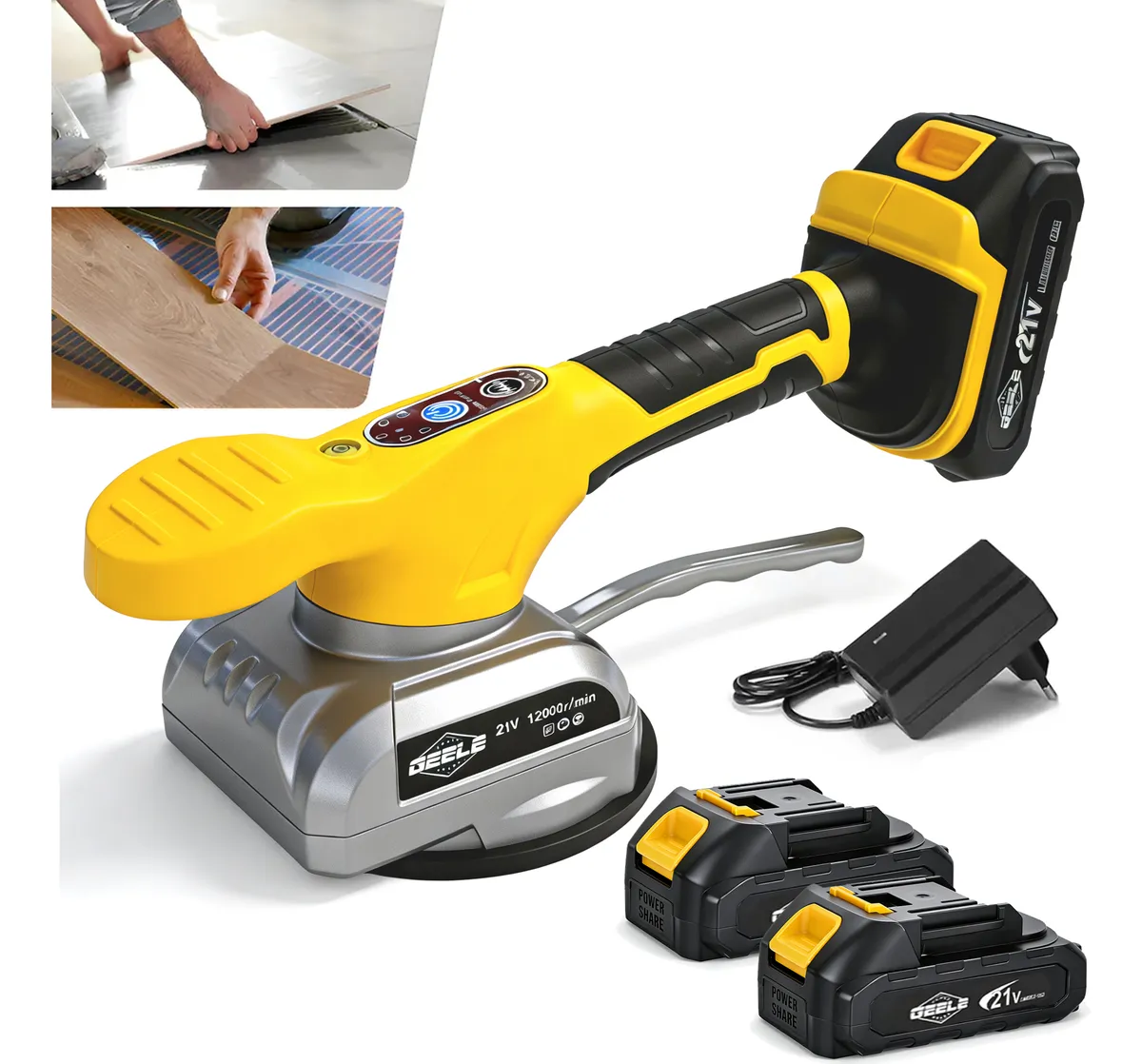
A practical look at a cordless vibrating suction tool designed to help position, vibrate and settle porcelain tiles, floor tiles and wall tiles with more control during installation.
The cordless vibrating tile suction cup is worth considering if you work with porcelain or ceramic tiles and want better control during placement, especially on larger pieces where manual handling becomes awkward. It makes more sense for installers, renovators and frequent DIY users than for someone doing a single very small repair. It can help with handling and vibration, but it does not replace correct adhesive preparation, leveling technique or careful alignment.
The cordless vibrating tile suction cup is a tool aimed at one of the most delicate parts of tile installation: placing the piece correctly before the adhesive begins to set. Its main appeal is combining a suction cup grip with vibration, helping the tile settle more evenly while giving the user a firmer way to hold and adjust the piece.
For porcelain tile, floor tile and wall tile work, this type of machine can reduce some of the strain of manual installation. The important point is understanding what it really does well and what still depends on the installer’s technique.
How this vibrating suction tool fits into tile installation
This product belongs to the category of cordless vibrating suction machines for tile laying. In practical terms, it is designed to grip the surface of a tile with a suction cup while applying vibration to help the piece settle into the adhesive bed.
That combination is useful because porcelain and ceramic pieces can be heavy, smooth and sometimes difficult to position precisely by hand. A suction handle gives the user a more controlled grip, while vibration can help distribute contact between the tile and the mortar underneath.
The cordless design is also relevant. Without a power cable in the work area, the installer has more freedom to move around the tile, adjust the angle and work in spaces where an outlet is not conveniently placed. This is especially helpful in bathrooms, kitchens, balconies and renovation areas where cables can get in the way.
The product is presented as a vibrating suction machine for laying floors and porcelain tiles, so its natural use is not cutting, drilling or leveling by itself. Its role is assisting the placement stage. That distinction matters because buyers sometimes expect this type of tool to solve every installation issue, when in reality it is one part of a complete tile-setting process.
Used correctly, it can support cleaner positioning and more consistent contact with the adhesive. Used carelessly, it will not correct a poorly prepared substrate, incorrect mortar consistency or rushed tile alignment.
The biggest mistake is expecting vibration to fix poor preparation
The most common buying error in this category is treating the machine as if it were a shortcut for the entire installation. A vibrating suction cup can help settle the tile, but it cannot compensate for uneven flooring, wrong adhesive choice, insufficient back-buttering or poor spacing.
Before using any vibrating tile machine, the surface still needs to be clean, level enough for the job and prepared according to the tile size and installation area. Large porcelain pieces, for example, often require more attention to adhesive coverage because hollow areas can lead to future cracking or loose tiles.
The suction function also depends on surface conditions. Smooth porcelain or polished tile surfaces are usually more suitable for suction than highly textured, dusty or irregular surfaces. If the tile surface prevents the cup from sealing properly, the tool may not hold as firmly as expected.
That does not make the product weak; it simply defines the right expectation. It is a handling and vibration aid, not a universal installation guarantee.
For buyers, the best approach is to see it as a tool that improves control when the rest of the job is already being done correctly. If the adhesive bed, tile spacing and leveling system are handled well, the vibrating suction cup can become a very useful support in the workflow.
What it improves during real installation work
The strongest practical benefit is control. Holding a smooth tile with bare hands can be uncomfortable, especially when the piece is large, heavy or already close to the adhesive bed. A suction tool gives the installer a handle, which can make small adjustments easier and reduce the chance of touching the adhesive unnecessarily.
The vibration function can also help during placement. Instead of relying only on tapping with a rubber mallet, the tool applies vibration across the contact area. This may help the tile settle into the mortar more evenly when used with proper technique.
Another useful point is comfort. Repetitive tile installation can be tiring on the hands, wrists and shoulders. A cordless vibrating suction cup can reduce some of that manual effort, especially during projects involving multiple pieces.
It can also make sense for more precise placement. When a tile is already close to its final position, small movements matter. The suction handle can help lift, nudge or reposition the piece with more confidence than trying to pinch the edges by hand.
For renovation work, the cordless format adds convenience. There is no cable dragging through wet mortar, no cord crossing the work zone and less need to stop the job because the tool cannot reach the area comfortably.
This type of tool is especially attractive for users who often install porcelain tiles, ceramic floors, wall tiles or similar smooth-surface pieces. It brings more benefit to repeated use than to occasional one-time repairs.
What may disappoint in everyday use
The first point of attention is that suction performance is not the same on every surface. Very textured tiles, dusty surfaces or uneven finishes can reduce grip. Before relying on the tool to lift or position a piece, the user should always confirm that the suction is holding securely.
Another point is that vibration does not replace leveling spacers, clips or correct alignment checks. It may help the tile settle, but it does not automatically eliminate lippage. For large-format porcelain tiles, leveling systems and careful adhesive coverage remain important.
Battery-powered tools also require planning. A cordless machine is convenient, but the user needs to keep it charged before starting the job. For longer installation sessions, interruption caused by low battery can be frustrating.
There is also a learning curve. The user needs to understand how much pressure to apply, when to vibrate, how to release the suction safely and how to avoid shifting the tile too much after it is aligned. The tool is not difficult in concept, but clean results still depend on controlled use.
It may also be unnecessary for very small tiles, minor repairs or jobs where the pieces are easy to handle manually. In those cases, a simple suction cup, rubber mallet and basic tile tools may be enough.
The most realistic expectation is this: the tool can make installation more controlled and comfortable, but it will not turn an inexperienced user into a professional installer by itself.
Power, suction and handling details to check before choosing
The product is described as a cordless vibrating suction machine for porcelain tile and floor installation. In this type of tool, the most important characteristics are not only the voltage or included accessories, but how the machine behaves during handling.
For practical use, the suction cup needs to create a reliable grip on smooth tile surfaces. The handle should feel stable enough to guide the piece without twisting excessively. If the tool feels unstable in the hand, precision can suffer.
The vibration should be strong enough to help settle the tile, but controllable enough not to move the piece out of position. Excessive or poorly controlled vibration can become a problem, especially when working close to tile spacers or edges.
The cordless battery format is a strong advantage for mobility. It allows the user to move around the room, work near walls and adjust pieces without managing a cable. For professional or semi-professional use, battery autonomy and charging routine become important parts of the workflow.
Included accessories can also influence convenience. A charger is essential for cordless use, and protective accessories such as gloves can be useful during tile handling. Still, accessories should be seen as support items, not the main reason to choose the tool.
For porcelain tile installation, the best performance comes when the machine is used together with correct mortar application, clean surfaces, proper spacing and regular level checks. The tool assists the process; the installation method still defines the final quality.
Best fit for installers, renovators and frequent DIY projects
This cordless vibrating tile suction cup is most suitable for users who install tiles more than occasionally. Professional installers, renovation workers and serious DIY users can benefit from the added control and reduced manual effort.
It is also a good match for projects involving larger tiles, smooth porcelain pieces or areas where accurate placement matters. Floors, bathroom walls, kitchens and renovation environments are natural use cases for this type of machine.
The tool makes sense for someone who wants to improve handling during placement. If the challenge is lifting, positioning and settling the tile without constantly touching the edges or adhesive, this product directly addresses that issue.
It can also be useful for people who already understand basic tile installation and want to make the process more efficient. Users who know how to prepare adhesive, align tiles and check levels are more likely to get good value from the tool.
For a small contractor or independent installer, the benefit is not only comfort. Better handling can help reduce rework, especially when dealing with pieces that are difficult to reposition by hand once placed.
For home users, it is more attractive when the project includes several tiles or a full room. A single small replacement may not justify the extra tool unless the user plans to keep it for future projects.
Cases where a simpler method may be enough
This machine may not be the best choice for someone who only needs to replace one or two small tiles. For very limited repairs, traditional hand tools may be enough and easier to justify.
It may also be less useful on tile surfaces where suction cannot seal properly. Highly textured finishes, dusty surfaces or irregular materials can reduce the effectiveness of the suction cup. In these situations, the user should not assume the tool will grip as securely as it does on smooth porcelain.
Beginners should also avoid thinking that the machine removes the need to learn installation basics. Tile setting still requires measuring, surface preparation, adhesive selection, spacing, leveling and cleaning. Without those fundamentals, the final result can still be poor.
The product may also frustrate users expecting a fully automatic solution. It does not install tiles by itself. It helps hold, position and vibrate the piece, while the user remains responsible for alignment and finish.
If the main problem is cutting tile, correcting uneven floors or choosing the right mortar, this is not the primary tool for that job. It is designed for the placement stage, not for every part of the installation process.
For occasional use, the buying decision should be based on how much tile work is planned in the future. The more frequent the installation tasks, the easier it is to justify having a dedicated vibrating suction tool.
How it compares with basic suction cups and larger tile tools
Compared with a basic manual suction cup, this cordless vibrating model offers a more complete function because it combines grip and vibration. A simple suction cup helps lift or hold the tile, but it does not actively assist with settling the piece into the adhesive.
Compared with using only a rubber mallet, the vibrating suction cup can feel more controlled on smooth porcelain surfaces. A mallet applies impact from specific points, while vibration can help distribute movement more evenly when the tile is already positioned.
Compared with more advanced professional tile handling systems, this tool is more focused and easier to use. Large-format tile systems may offer stronger support for very big pieces, but they are also bulkier and more specialized. This product sits in a more practical middle ground for common floor and porcelain tile work.
Its best comparison is not with every tile tool, but with the manual effort it replaces. If a user normally struggles to hold smooth tiles, adjust placement and settle the piece without shifting it too much, the vibrating suction machine offers a clear practical advantage.
For highly demanding professional installations, it should be seen as one tool in the kit rather than the only solution. Leveling clips, spacers, adhesive trowels, measuring tools and surface preparation equipment still matter.
For renovation and everyday installation work, the appeal is balance. It adds control without making the workflow overly complex, especially for users who want a cordless tool that can move freely around the job site.
The decision comes down to control, frequency of use and tile size
The cordless vibrating tile suction cup is a smart choice when the user wants more confidence during tile placement. It is particularly useful for porcelain tile installation, floor tile work and smooth ceramic surfaces where grip and vibration can support a cleaner result.
It is strongest when used by someone who already follows correct installation practices. With proper adhesive coverage, clean surfaces and careful alignment, the tool can make the placement stage smoother and more controlled.
It is less convincing for very small, occasional jobs or surfaces where suction does not work well. In those cases, simpler tools may be enough.
For installers and frequent renovators, the value is practical: better handling, less physical effort and more control when placing tiles. For DIY users, it can be a useful upgrade if the project is large enough and the user is willing to learn the correct technique.
Does a cordless vibrating tile suction cup help install porcelain tile?
Yes, it can help with porcelain tile installation by improving grip and applying vibration during placement. It is most useful on smooth tile surfaces where the suction cup can seal properly. The tool can make handling easier, but the final result still depends on adhesive coverage, leveling, spacing and surface preparation.
Can this type of tool replace a rubber mallet?
No, it should not be viewed as a complete replacement in every situation. The vibration function can reduce the need for repeated tapping and may help settle the tile more evenly, but some installers may still use a rubber mallet carefully when needed. The best method depends on tile size, adhesive bed and installation technique.
Is it suitable for wall tiles as well as floor tiles?
Yes, it can be useful for wall tiles if the surface is smooth enough for suction and the tile size is manageable for the user. On walls, control is especially important because the tile must be positioned accurately without sliding. Proper adhesive choice and support remain essential for safe installation.
Does the cordless design make a real difference?
Yes, cordless operation can make a noticeable difference on job sites where mobility matters. Without a cable, the user can move around the room more freely and avoid dragging wires through the work area. This is helpful in bathrooms, kitchens and renovation spaces where access can be limited.
Can beginners use a vibrating suction machine for tiles?
Yes, beginners can use it, but they should not skip learning the basics of tile installation. The tool can help with handling and vibration, yet it does not solve mistakes in leveling, adhesive application or spacing. A beginner will get better results by using it as support, not as a shortcut.
What surfaces work best with the suction cup?
Smooth porcelain and ceramic surfaces usually work best because the suction cup needs a clean, even surface to seal properly. Textured, dusty or irregular tiles may reduce grip. Before lifting or positioning a tile, the user should always test whether the suction is secure enough for safe handling.
Is it useful for large-format tiles?
Yes, it can be helpful with larger tiles because those pieces are harder to hold and adjust by hand. The suction grip can improve control, while vibration may help the tile settle into the adhesive. For very large or heavy pieces, additional handling support and professional technique may still be necessary.
What should I check before using it on a project?
Check that the battery is charged, the suction cup is clean, the tile surface allows a secure seal and the adhesive bed is properly prepared. It is also important to test the vibration before placing the tile. Good preparation makes the tool more effective and reduces the chance of movement or poor contact.
The cordless vibrating tile suction cup is a useful tool for people who want more control when installing porcelain and floor tiles. Its main strengths are easier handling, cordless mobility and vibration support during placement.
It is a better fit for repeated use, renovation work and tile projects where smooth surfaces and accurate positioning matter. It is not a miracle tool, and it will not correct poor preparation or replace installation technique. But when used in the right context, it can make tile laying feel more controlled, more comfortable and more efficient.