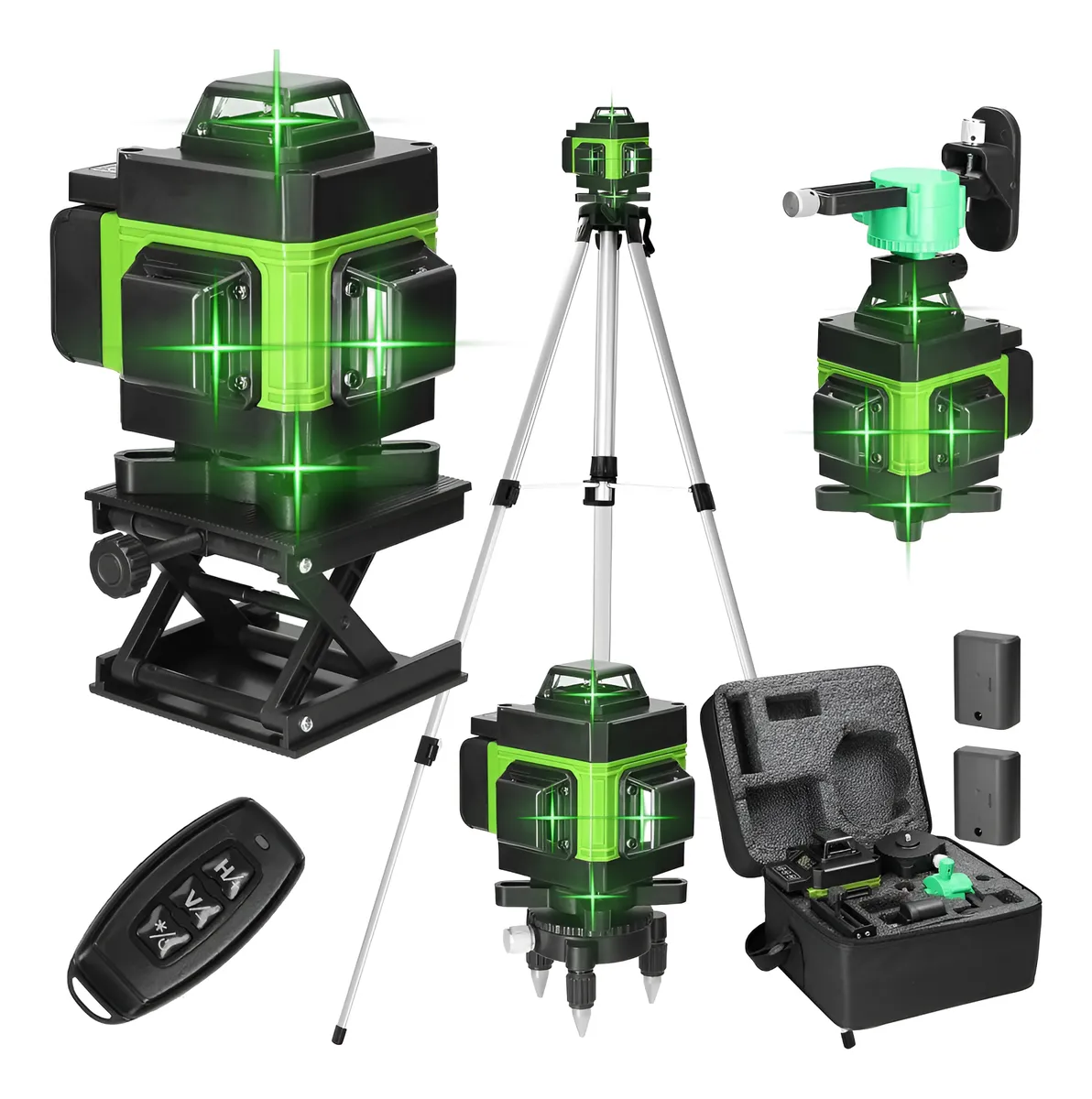
The green 12-line laser level kit is designed for people who need faster alignment in renovation, installation and construction tasks without relying only on manual marks, bubble levels or repeated measurements.
It makes sense if you want a complete layout kit for tiles, drywall, shelves, ceiling work, floor marking and general alignment jobs. The strongest appeal is the combination of green laser lines, 3D projection, rechargeable operation and included accessories. The main point of attention is the tripod, which is useful for light work but may feel too delicate for rough jobsite handling.
A laser level can save a lot of time when the job depends on straight reference lines. This kit targets that exact need: it projects multiple green lines, includes support accessories and is meant to help with horizontal, vertical and square alignment in different positions.
The product is not positioned as a heavy-duty industrial instrument for extreme conditions. Its best value is in practical layout work where visibility, speed and convenience matter more than having the most rugged tripod or the most advanced professional body.
What the 12 green laser lines are meant to solve
This kit is built around a 3D green laser level with 12 projected lines. In practical use, that means it can help create horizontal and vertical references around a room, making it useful for jobs where alignment needs to continue across walls, floors or ceiling areas.
The green beam is one of the most important details. Green laser lines are generally easier to see indoors than red laser lines, especially in brighter rooms. This does not mean visibility will be perfect in every situation, because strong daylight and reflective surfaces can still reduce clarity, but it does make the tool more comfortable for many indoor layout tasks.
The listing presents the tool as suitable for wall, ceiling and floor applications. That makes sense for common jobs such as installing tiles, aligning drywall profiles, checking shelves, marking cabinets, positioning frames, setting electrical points, guiding ceiling details and creating square references for renovation work.
The 12-line design is especially useful when you do not want to keep moving the tool for every mark. A simpler laser level may be enough for one wall or one short reference, but a 3D 12-line model offers more complete coverage and can reduce interruptions during layout.
The kit also includes accessories that make it more flexible out of the box. It comes with a tripod, wall support with magnet, transport case, charger, two rechargeable batteries and remote control. For a user who does not already own mounting accessories, that complete package is a major part of the appeal.
The tripod is the detail that deserves attention before choosing the kit
The most important buying mistake in this category is looking only at the laser and ignoring how the tool will be positioned. A laser level can project good lines, but if the tripod or support is unstable, the user may spend more time correcting the setup than doing the actual work.
In this kit, the laser itself is the most attractive part, while the tripod should be treated as a convenience accessory rather than a rugged jobsite stand. The included tripod is described as adjustable, with aluminum rods, quick adjustment and movement options, but buyer feedback points to a common concern: it can feel sensitive or fragile if handled roughly.
That does not automatically make the kit a bad choice. For careful use, indoor renovation, occasional jobs, home projects and lighter professional work, the tripod can still be useful. The problem appears when the buyer expects the same firmness as a heavier professional tripod made for daily abuse on construction sites.
If your work involves constant movement, uneven surfaces, dusty environments, tools being carried in a truck every day or several people handling the equipment, the tripod may be the first part you will want to upgrade. In that case, the better strategy is to judge the kit mainly by the laser unit and treat the tripod as an included starter accessory.
How the kit helps with tiles, drywall, shelves and layout marks
The practical advantage of a 12-line green laser level is speed. Instead of marking several points manually, checking the bubble level repeatedly and correcting small deviations, the user can project reference lines and work with a more consistent visual guide.
For tile installation, this can help keep rows aligned and reduce visual errors that become obvious only after several pieces are placed. For drywall and ceiling work, the laser lines can support the positioning of profiles, panels and reference points across larger areas.
For shelves, cabinets and decorative items, the tool can also be useful because it helps align several points at once. This is especially valuable when installing more than one element on the same wall, such as floating shelves, picture frames, wall panels or support brackets.
The vertical and horizontal line controls add flexibility. The remote control is also a practical feature because it allows adjustment without touching the unit every time. That matters when the laser is positioned on a tripod or mounted in a spot where small movements could affect alignment.
The magnetic wall support is another relevant accessory. It helps when the laser needs to be fixed to a metallic surface or positioned close to a wall. For many installation jobs, a wall support can be more convenient than a tripod, especially when the working height or angle is difficult to reach from the floor.
The transport case helps protect and organize the parts. With laser tools, storage matters because impacts, dust and loose accessories can shorten the useful life of the kit. A case does not make the tool indestructible, but it reduces the chance of losing batteries, chargers, supports and smaller components.
Where the kit asks for realistic expectations
The kit is attractive because it offers many functions and accessories in one package, but it should not be mistaken for a premium industrial laser system. The body, tripod and accessories need careful use, especially if the tool will be used frequently in harsher environments.
The laser reach is presented as up to 30 meters, with performance depending on ambient light. This is an important detail. Indoors, the green beam should be much easier to work with. Outdoors or under strong light, the line can lose visibility, and the user may need better shade, closer distance or additional checking.
The precision information is also something to interpret correctly. The product information presents precision in practical jobsite terms, making it suitable for alignment and installation work. It is not the kind of tool a buyer should choose for specialized surveying or technical measurement tasks that demand certified instruments and strict calibration documentation.
The tripod height is useful for many everyday applications, but it may not cover every scenario. For higher ceiling work, large rooms or very specific professional setups, a taller and heavier stand may be more appropriate.
Another point is the generic nature of the product title and branding. The listing identifies Exbom as the manufacturer, but the product is presented with a broad descriptive name rather than a clean model family. That is common in this category, but it means buyers should focus on the actual features, included items and practical use rather than expecting a premium brand experience.
Laser visibility, power setup and included accessories
The kit uses a green laser beam and projects 12 lines. It is described as a rechargeable tool and includes two rechargeable batteries, which is convenient for longer work sessions. Having two batteries is better than relying on only one, because it allows the user to keep working while one battery is not in use.
The charger is included, and the listing describes the charger as bivolt. This helps reduce compatibility concerns for normal household and jobsite power conditions, although the user should still check the charger label before use.
The tool includes auto-leveling through a pendulum system. Auto-leveling is one of the most useful features in a laser level because it reduces manual adjustment and helps the user get usable reference lines faster. The alarm beep for irregular positioning is also useful because it warns when the tool is not sitting correctly.
The laser can be used on the floor, on a wall support or on the tripod. This flexibility matters because different jobs require different positioning. Floor use can help with tile layout and base references. Wall support can help with vertical placement. Tripod use gives more freedom when working away from fixed surfaces.
The kit also includes a remote control. This is not just a convenience feature; it can protect alignment. When the user touches the laser body directly, even a small movement can change the projected line. Remote operation reduces that risk and makes the workflow smoother.
The tripod is described with a three-axis head, adjustable aluminum rods, quick adjustment and the ability to support angled positioning. These are useful features for a starter tripod, but the user should still handle it carefully and avoid forcing joints, clamps or extension parts.
The buyer who will get the most from this setup
This green 12-line laser level kit makes the most sense for people who need a practical alignment tool for renovation, finishing and installation work. It is especially attractive for users who want the laser, tripod, wall support, batteries and case together instead of buying each accessory separately.
It fits well for tile installers, drywall workers, painters, furniture installers, electricians, decorators and homeowners doing serious DIY projects. The tool helps when visual alignment directly affects the final appearance of the job.
It is also a sensible option for someone moving from a basic bubble level to a more efficient laser setup. The learning curve is not complicated, and the included accessories make it easier to test different positioning options.
The kit is a good match for indoor work. Rooms, apartments, shops, offices and covered construction areas are the environments where the green beam and multi-line projection can be most useful. In these situations, the buyer can take advantage of the 12 lines without fighting too much against sunlight.
It also works for users who need occasional professional support but do not want an overly complex setup. The remote control, auto-leveling, rechargeable batteries and case make the tool more convenient than a very basic laser level.
When a sturdier tool is the smarter move
This kit is not the best direction for buyers who mainly need a heavy-duty tripod and reinforced accessories. If the tool will be used every day on rough construction sites, with constant transport and tough handling, a more robust professional set may be a better long-term decision.
It may also frustrate users who expect perfect outdoor visibility in bright sunlight. Green lasers are easier to see than many red lasers, but light conditions still matter. For outdoor layout, the buyer may need a receiver-compatible laser or a more specialized instrument.
Another case where this kit may not be ideal is technical measurement work that requires certified accuracy, calibration control or documented compliance. This product is better understood as a practical layout and alignment tool, not as a substitute for professional surveying equipment.
Users who already own a strong tripod and wall support may also consider buying only a laser unit, depending on their needs. The complete kit is most attractive when the accessories are useful. If the buyer will replace the tripod immediately, the decision should focus on whether the laser unit itself meets the intended use.
How it compares with simpler levels and premium jobsite kits
Compared with a basic manual level, this kit is much faster for multi-point alignment. A bubble level is still useful for quick checks, but it cannot project reference lines across a room. For tasks like tile rows, ceiling lines or cabinet placement, the laser offers a clear workflow advantage.
Compared with a simple cross-line laser, the 12-line design gives more coverage. A basic cross-line model can be enough for hanging frames or installing a small shelf, but it becomes limited when the job needs multiple planes or continuous references around a space.
Compared with premium construction-grade kits, this product is more about completeness and practical usability than ruggedness. A higher-end kit may offer stronger housing, better tripod quality, stronger mounting hardware, more advanced outdoor performance and more consistent long-term durability.
The right comparison is not just about the laser line count. It is about how the tool will be used. If the buyer needs a complete indoor layout setup for renovation and installation, this kit is appealing. If the buyer needs equipment for heavy site abuse, the accessory quality becomes a stronger concern.
The strongest position of this product is the balance between 3D green laser projection, included accessories and ease of use. The weakest point is that the support system does not appear to be as confidence-inspiring as the laser’s feature list.
A practical decision for accurate indoor layout work
The green 12-line laser level kit is worth considering if your main goal is to improve speed and alignment in indoor renovation, finishing and installation tasks. It offers the essential elements most users want: green beam, 12-line projection, auto-leveling, rechargeable batteries, wall support, tripod, case and remote control.
The best way to approach this kit is to see it as a capable laser package with a light-duty accessory set. The laser features are the main attraction. The tripod is useful, but it should be handled carefully and may not satisfy users who expect professional-grade rigidity.
For tile work, drywall references, shelves, cabinets, ceiling marks and general alignment, the kit can be very practical. It helps reduce guesswork and gives the user a clearer visual guide, especially in indoor spaces where the green beam is easier to see.
For outdoor work, heavy construction routines or precision-critical measurement tasks, expectations should be more cautious. In those cases, a more specialized or rugged tool may be a better match.
Is the green 12-line laser level kit good for tile installation?
Yes, it can be very useful for tile installation because it projects horizontal and vertical references that help keep rows aligned. The 12-line design is especially helpful when the layout needs to continue across walls or floors. The main care point is keeping the tool stable while working.
Can this laser level be used outdoors?
Yes, but outdoor performance depends heavily on light conditions. The green beam is generally easier to see than a red beam, but strong sunlight can still make the line harder to follow. For frequent outdoor work, a more specialized setup may be more reliable.
Does the included tripod feel professional enough?
It depends on the type of use. The tripod is useful for lighter tasks, careful indoor work and occasional positioning, but it should not be treated like a rugged heavy-duty stand. Users who work daily on rough jobsites may prefer a stronger tripod.
What does the 12-line design actually help with?
It helps create multiple reference lines around the working area, reducing the need to reposition the laser constantly. This is useful for drywall, tiles, shelves, ceiling work, floor layout and other tasks where horizontal and vertical alignment need to stay consistent.
Is the kit suitable for beginners?
Yes, it is suitable for beginners who want a more efficient alignment tool than a manual level. Auto-leveling, rechargeable batteries and included supports make the setup easier to use. Beginners should still read the instructions carefully and avoid forcing the tripod or mounts.
Are the rechargeable batteries a real advantage?
Yes, having rechargeable batteries is practical because it reduces dependence on disposable power sources and helps keep the tool ready for repeated use. The inclusion of two batteries is also helpful, especially for longer jobs or when one battery needs charging.
Is this kit better than a simple cross-line laser?
Yes, for larger or more complex layout work, the 12-line kit is more versatile than a simple cross-line laser. A basic model may be enough for small tasks, but this kit offers broader projection coverage and more mounting flexibility for renovation and installation jobs.
What should be checked before choosing this laser level?
The main things to check are the intended work environment, tripod expectations and visibility needs. It is strongest for indoor alignment and practical renovation tasks. It is less ideal for rough handling, bright outdoor work or specialized measurement jobs that require certified professional instruments.
For buyers who want a complete laser alignment kit for indoor work, the green 12-line model is a strong practical choice. It offers enough versatility for many renovation, installation and finishing tasks, while the included accessories make it easier to start using the tool immediately.
The smartest expectation is simple: buy it for the laser projection, green visibility, rechargeable setup and accessory convenience, but be realistic about the tripod. If the tool will be handled carefully, the kit can deliver very useful results. If the work routine is demanding and rough, pairing the laser with a sturdier support may be the better long-term path.