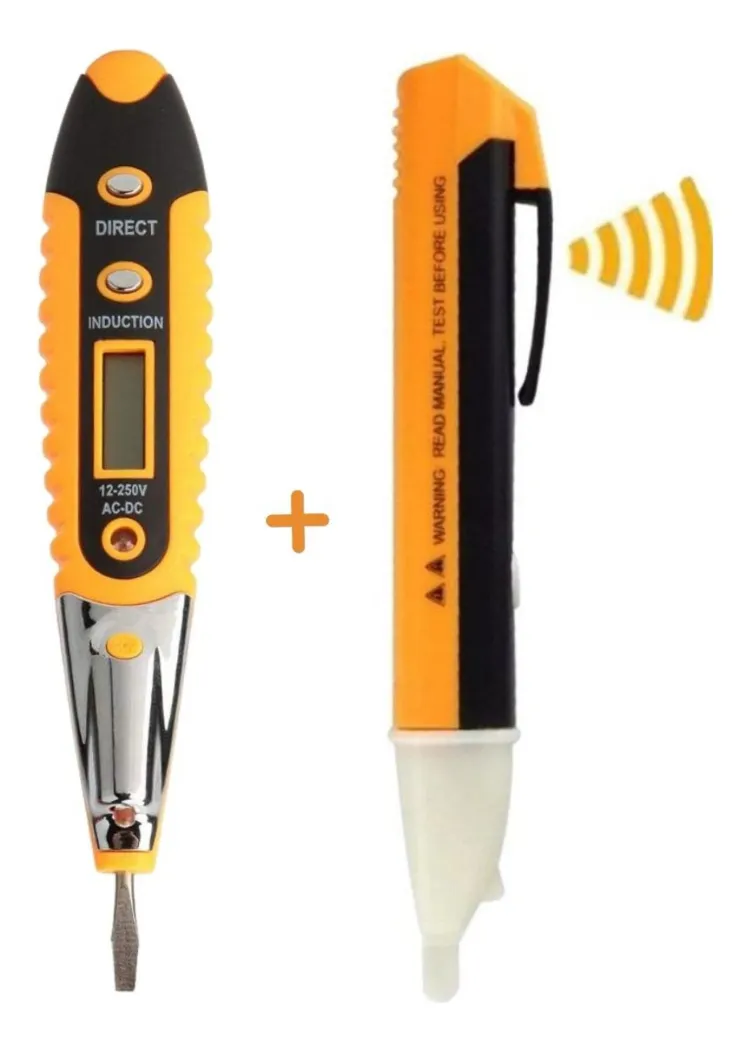
A compact electrical checking kit for quick voltage indication, basic troubleshooting and safer first checks around outlets, switches and energized conductors.
The B Basto digital test screwdriver and voltage detector pen kit makes sense for users who want a simple, portable way to identify the presence of voltage before basic electrical inspection tasks. It is best viewed as a convenience kit for quick checks, not as a full diagnostic setup for professional electrical measurement. The strongest appeal is having two complementary tools in one small package: a digital test screwdriver for contact checks and a non-contact voltage detector pen with visual and audible indication.
The B Basto digital test screwdriver and voltage detector pen kit targets a very common need: checking whether there may be voltage present before touching, replacing or inspecting an electrical point. For home users, maintenance helpers and beginner tool kits, that kind of first check can be useful when handled carefully.
The key point is understanding what this kit can and cannot do. It is designed for indication and preliminary verification, not for replacing a certified multimeter, a professional voltage tester or proper lockout safety procedures when working on electrical systems.
What this B Basto electrical checking kit is designed to do
This kit combines two tools that serve related but different purposes. The voltage detector pen is used without direct metal contact with the conductor, helping identify the possible presence of alternating voltage through light and sound alerts. The digital test screwdriver is a contact-style tool intended for simple checks on energized points within its supported use case.
The detector pen is the more convenient part for fast screening. It is useful when checking outlets, switch boxes, extension cords, power strips, cables and areas where the user wants to know whether voltage may be present before going further.
The confirmed operating range for the detector pen is from 90V to 1000V, which places it in the typical household and general low-voltage inspection category. That range makes it more suitable for common residential and light maintenance checks than for low-voltage electronics, automotive circuits or delicate board-level testing.
The luminous and audible alert system is important because it gives two types of feedback. A light signal helps when the environment is quiet or when the user is visually focused on the test point. A sound alert helps when the tool is being used in a cramped position or when visibility is not ideal.
The kit is also compact. That matters because electrical checking tools are often needed in drawers, tool bags, vehicles, maintenance pouches or quick service kits. A small set is easier to keep available than a larger diagnostic instrument that the user may not want to carry for basic inspections.
The biggest mistake is treating it like a complete measuring instrument
The most important buying decision with this kit is not whether it can detect voltage. It is whether the buyer understands the difference between voltage indication and voltage measurement.
A non-contact detector pen is excellent for a first warning. It can help show that voltage may be present near a wire, outlet or cable. However, it does not provide the same level of certainty, precision or diagnostic depth as a proper multimeter or a professional two-pole voltage tester.
This matters because electrical environments can produce confusing results. Nearby energized conductors, cable shielding, moisture, grounding conditions, weak fields or user technique can affect how a detector pen behaves. In some situations, the pen may alert near a live conductor without giving enough context. In other situations, a weak or hidden conductor may require more careful verification.
The digital test screwdriver also should not be treated as a substitute for professional testing. Contact testers can be useful for quick checks, but they are not the right tool for diagnosing complex faults, confirming circuit integrity, measuring exact voltage, checking current, testing resistance or validating grounding quality.
This kit makes more sense when used as a first layer of caution. Before touching a wire or opening a fixture, it can help the user pause and identify a possible hazard. After that, any real electrical work should still follow safe isolation and verification practices.
Where the two-tool format helps in real use
The best practical advantage of this kit is that it gives the user two ways to approach a basic check. The detector pen is useful when direct contact is not desirable at the beginning. The test screwdriver can then support a simple contact-style verification when the situation is appropriate.
For outlet checks, the pen can quickly indicate whether voltage may be present around the faceplate or cable path. For switches, it can help identify whether a circuit might still be energized before removing covers. For extension cords and power strips, it can help identify whether power is reaching the area being inspected.
It also has value for simple home organization. When several cables are close together, a non-contact voltage detector can help identify which cable may be energized. This is especially useful behind furniture, near workbenches, around appliance areas or in temporary setups where cables are not clearly labeled.
Another advantage is speed. A full multimeter setup is better for measurement, but it takes more time and requires choosing the correct range, probes and contact points. A detector pen is faster for an initial yes-or-no style warning.
The audible and visual alert combination helps reduce hesitation for casual users. Instead of interpreting a small display or needle, the tool gives a simple alert pattern. That does not make the result absolute, but it does make the kit approachable for basic screening.
The compact size also encourages better habits. A simple detector that is close at hand is more likely to be used before opening a switch box or touching a cable. In that sense, the kit can support safer behavior, as long as the user does not overtrust it.
What can frustrate more demanding users
This kit can disappoint buyers who expect professional diagnostic capability. It is not the right choice for detailed fault finding, panel work, industrial maintenance, electronics repair or situations where exact voltage readings are required.
The detector pen works within a voltage detection range, but it does not tell the user the exact voltage present. It also does not diagnose polarity, current draw, resistance, continuity, frequency or load behavior. For those tasks, a multimeter or a dedicated electrical testing instrument is the more appropriate tool.
The non-contact design is convenient, but it can also be misunderstood. These tools respond to electric fields, not to a complete technical diagnosis of the circuit. That means the user must interpret alerts carefully and avoid using the pen as the only proof that something is safe to touch.
The digital test screwdriver is also better for simple checking than for serious electrical work. If the user is already comfortable with professional tools, this part of the kit may feel basic. It is more useful as a quick-access accessory than as the main instrument in a technician’s bag.
Another point of attention is build expectation. Compact entry-level checking kits are usually chosen for practicality and convenience, not for heavy-duty jobsite abuse. Anyone who needs rugged daily-use tools should compare insulation rating, safety category, certification details and build quality before deciding.
The kit also does not remove the need for electrical knowledge. A voltage alert is not a work authorization. Safe electrical work still requires switching off the circuit, confirming isolation with the right tool, using proper protection and understanding the installation being handled.
Detection range, alerts and practical performance
The detector pen’s 90V to 1000V range is the central specification to understand. It places the pen in the category of tools designed mainly for detecting common AC voltage in residential and general electrical environments.
This means it is more relevant for outlets, switches, light circuits, extension cords and general mains-related checks. It is not the best option if the user’s main need is testing batteries, low-voltage DC systems, automotive wiring, USB circuits, small electronics or sensor wiring.
The luminous and audible alert format is practical for fast checking. When the pen approaches an energized area within its detection capability, the user gets a clear warning pattern. This is useful for preliminary screening, especially in situations where touching the conductor directly is not the safest first move.
The digital test screwdriver adds another layer for basic contact checks. Its role is more traditional: it helps the user verify electrical presence in a direct way when used correctly and within its intended application. This is useful for simple household troubleshooting but should not be confused with full measurement.
Performance in real use will depend heavily on technique. The user should test the detector on a known live source before relying on it, then test again after use to confirm the tool is still responding. This habit helps reduce the risk of trusting a tool with weak batteries, poor contact, damage or incorrect handling.
It is also wise to approach testing from more than one angle. For example, checking an outlet from both sides, moving along the cable path and confirming behavior on a known energized point gives a more reliable practical impression than a single quick pass.
The type of buyer who will get the most from this kit
This kit fits users who want a simple electrical safety helper for everyday checks. It is especially suitable for people who occasionally inspect outlets, switches, extension cords, lamps, appliances or cable paths and want a quick way to detect possible voltage before proceeding.
It also makes sense for a basic home tool kit. Many households have screwdrivers, pliers and tape, but no simple way to check for voltage presence. Adding a detector pen and test screwdriver can make small inspection tasks more cautious.
Beginner maintenance users may also appreciate the format. The tools are easy to carry, easy to store and easy to understand at a basic level. The visual and audible alert system reduces the learning curve compared with instruments that require interpreting numerical readings.
For rental properties, small workshops, office maintenance drawers and light service bags, the kit can be useful as a fast screening option. It helps identify when an electrical point deserves more care or when a qualified electrician should be called.
It also suits people who want a secondary tool rather than a primary instrument. Even users who own a multimeter may keep a voltage detector pen nearby because it is faster for an initial warning before bringing out a more complete tester.
When another electrical tester is the smarter choice
This is not the best option for anyone who needs precise readings. If the goal is to know the exact voltage, test continuity, measure resistance, diagnose appliances, check capacitors, test DC circuits or troubleshoot electronics, a multimeter is the more suitable tool.
It is also not ideal as the only tool for professional electrical service. Electricians and advanced maintenance workers generally need instruments with clearly documented safety ratings, stronger insulation standards, better durability and more complete testing capability.
Anyone working in panels, industrial environments or unknown installations should be especially careful. In those scenarios, a simple detector pen and digital test screwdriver are not enough to establish a safe work condition.
The kit may also frustrate users who expect one tool to solve every electrical doubt. It is better at answering “is there likely voltage here?” than at answering “what exactly is wrong with this circuit?” That distinction is central to satisfaction after purchase.
For low-voltage projects, such as automotive wiring, hobby electronics, LED strips, small power supplies or battery circuits, the detector pen’s range makes it less relevant. A multimeter or specialized low-voltage tester will usually be more useful.
How it compares with larger electrical testing sets
Compared with a single non-contact voltage pen, this kit is more versatile because it adds a contact-style test screwdriver. That combination gives the user more flexibility for simple checks without moving immediately to a larger instrument.
Compared with a multimeter kit, however, it is much simpler. A multimeter can measure voltage more precisely and handle more diagnostic functions, while this kit focuses on fast detection and basic indication. The B Basto kit wins on simplicity and portability, but it loses on technical depth.
Compared with professional two-pole voltage testers, this kit is more casual. Two-pole testers are generally better for confirming absence or presence of voltage in a more controlled way, especially for electrical work. The detector pen is more convenient for screening, but not equivalent in certainty.
Compared with larger electrician bundles that include a multimeter, clamp meter or multiple accessories, this kit is more focused. It avoids complexity and works better for buyers who want only a simple first-check setup. That makes it less intimidating, but also less complete.
The best way to see this kit is as a lightweight companion. It is not trying to be a full electrician’s diagnostic station. It is a practical pair of tools for quick caution, basic identification and everyday electrical awareness.
A clear buying decision for everyday electrical checks
The B Basto digital test screwdriver and voltage detector pen kit is a sensible choice when the buyer wants quick voltage indication in a small, easy-to-carry format. It is especially useful for household checks, light maintenance and situations where the first question is whether voltage may be present.
Its best qualities are simplicity, portability and the two-tool combination. The detector pen gives non-contact convenience with light and sound alerts, while the digital test screwdriver adds a more traditional contact-check option for basic situations.
The main caution is expectation. This is not a professional measurement system and should not be treated as the final authority before touching conductors or starting electrical work. It is a warning and screening kit, not a replacement for safe isolation, technical knowledge or proper measuring tools.
For the right user, that is enough. For someone building a basic tool kit or wanting an extra layer of caution before simple inspections, it offers a practical balance between ease of use and everyday utility.
Can the B Basto voltage detector pen identify live wires without touching them?
Yes, the detector pen is designed for non-contact voltage indication within its supported range. It can help identify the possible presence of AC voltage near wires, outlets, switches and cords. It should still be treated as a preliminary warning tool, not as the only proof that a conductor is safe or unsafe.
Does this kit replace a multimeter?
No, this kit does not replace a multimeter. It is made for quick voltage indication and basic checking, while a multimeter can provide numerical readings and additional functions such as continuity, resistance and DC voltage testing. For detailed diagnosis, a multimeter remains the better tool.
Is the detector pen suitable for household outlets?
Yes, the detector pen is suitable for common household-style voltage checks when used within its operating range. It can help screen outlets, switches, power strips and extension cords. The user should first test the pen on a known live source and follow safe electrical practices before touching or opening anything.
Can beginners use this electrical testing kit?
Yes, beginners can use it for simple preliminary checks, provided they understand its limits. The light and sound alerts make the detector pen approachable, but electrical work still carries risk. Beginners should avoid opening circuits or handling wiring unless they know how to isolate power safely.
What is the main advantage of buying the kit instead of only the pen?
The main advantage is having two complementary checking styles in one small set. The pen helps with non-contact screening, while the digital test screwdriver can support simple contact-style checks. This makes the kit more flexible for basic home and maintenance use than a single detector alone.
Will it work for car wiring or low-voltage electronics?
No, it is not the ideal choice for car wiring or low-voltage electronics. The detector pen is centered on higher AC voltage detection, which makes it more useful for mains-related checks than for batteries, vehicle circuits, USB power, small electronics or delicate DC systems.
How should this kit be used more safely?
Use it first on a known live source, then check the area you want to inspect, and confirm the tool still responds afterward. Do not rely on only one quick pass. For real electrical work, switch off the circuit, verify isolation with appropriate tools and call a qualified professional when unsure.
Who should choose a more advanced tester instead?
Professionals, advanced maintenance users and anyone working in panels or complex installations should choose a more advanced tester. A simple detector pen and test screwdriver are useful for screening, but they do not provide the precision, durability or safety confidence required for demanding electrical work.
The B Basto kit is worth considering as a compact first-check tool for everyday electrical awareness. It gives the user a quick way to detect possible voltage, adds a second contact-check accessory and stays simple enough for basic tool kits.
Its real value appears when it is used with the right mindset. It helps the user identify risk sooner, but it does not remove the need for safe procedures or more complete instruments when the job becomes technical.
Choose it if you want a practical, portable kit for quick voltage indication around common electrical points. Choose something more advanced if your priority is precise measurement, professional diagnosis or work in higher-risk electrical environments.