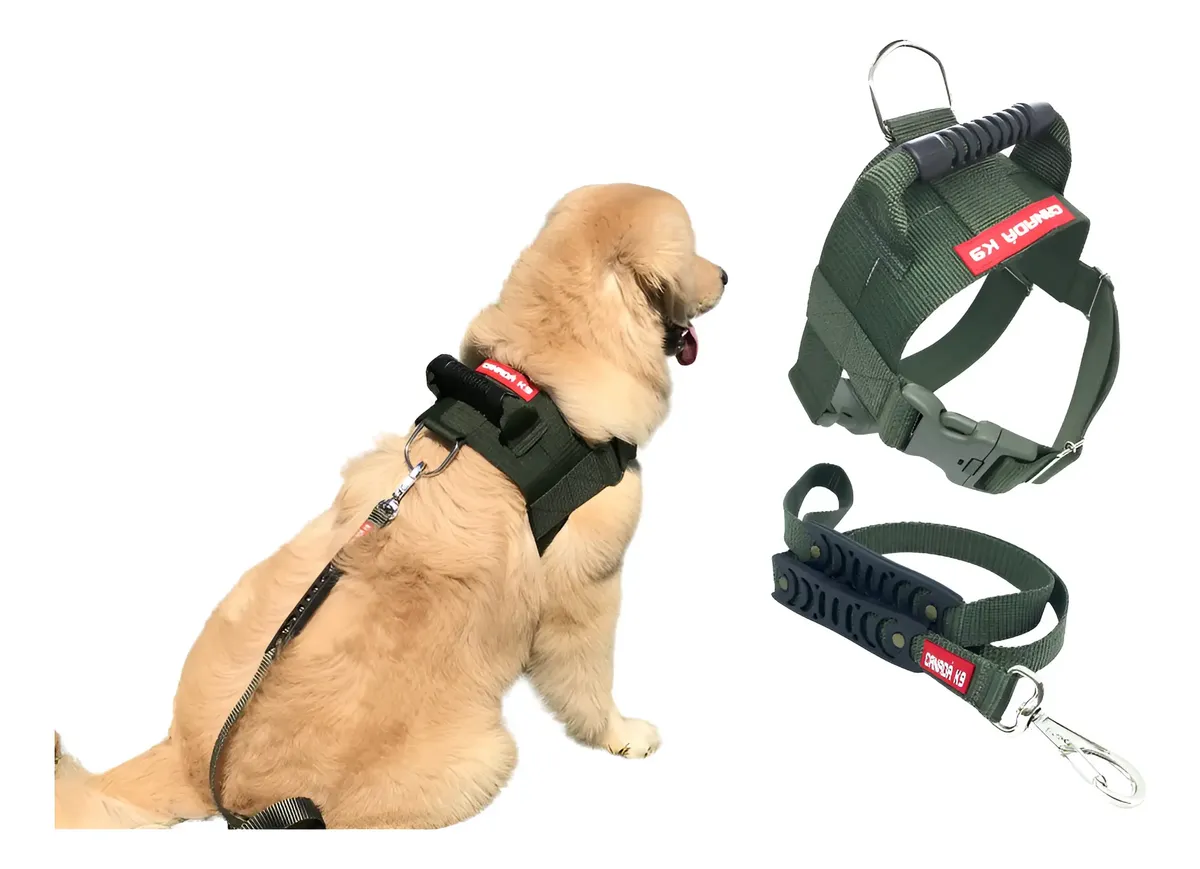
A tactical-style harness set designed for strong large-breed dogs that need better control, secure adjustment and a more stable walking experience.
The Canada K9 harness with leash is a strong option for owners of large dogs such as Golden Retrievers, Labradors, Rottweilers and similar breeds. It makes the most sense when the priority is control, chest stability and a secure fit rather than a lightweight minimalist accessory. It may feel excessive for calm dogs, small routines or owners who prefer very discreet walking gear.
This Canada K9 harness review focuses on what matters before choosing it for a large dog: fit, control, comfort, material strength and daily usability. The product is aimed at dogs with a broad chest and enough physical strength to make a regular collar or very light harness feel insufficient.
The main decision is not only whether the harness looks resistant. The real question is whether its tactical-style construction, wide straps, safety buckle system and handle match your dog’s body, behavior and walking routine.
What the Canada K9 SWAT GG harness is built to do
The Canada K9 SWAT GG harness with leash is a chest harness set for large dogs. It is designed for breeds with a stronger body structure, especially dogs that need firmer handling during walks, training moments or outdoor use.
The product is presented with a tactical-inspired design, wide polypropylene straps, reinforced stitching, adjustable front and rear sections, injected nylon buckles with a safety lock and a rear handle for extra control. These are the elements that define the product more than its visual style.
For a Golden Retriever or Labrador, the appeal is clear. These breeds are friendly and highly trainable, but they can also pull strongly when excited, especially in parks, streets with other dogs, or during the first minutes of a walk. A harness that distributes pressure across the chest can be more practical than relying only on a neck collar.
The included leash also makes the set more complete for someone who wants a ready walking combination. That matters for buyers who do not want to match a separate leash, hardware style and harness size on their own.
This is not a delicate fashion accessory. It is closer to a control-oriented walking and handling product. The SWAT-style appearance, the thicker structure and the wide strap design suggest a harness made for owners who prioritize security and resistance over a soft, barely visible fit.
The fit question that matters most before choosing this harness
The most important point before buying this Canada K9 harness is chest measurement. The GG size is indicated for dogs with a chest circumference from 80 cm to 100 cm and an approximate body weight range from 30 kg to 50 kg.
Between weight and chest circumference, the chest measurement should be treated as the deciding factor. This is especially important for large breeds because two dogs with the same weight can have very different body shapes. A lean Labrador, a broad Rottweiler and a fluffy Golden Retriever may all sit differently inside the same size range.
A harness that is too loose can rotate, rub, shift during pulling and reduce control. A harness that is too tight can restrict shoulder movement, create pressure points and make the dog resist wearing it. The best fit should feel firm, centered and stable without squeezing the body.
The front and rear adjustment system helps refine the fit, but adjustment does not replace measuring. Owners should measure around the widest part of the chest, usually behind the front legs. This gives a more realistic idea of whether the GG size is appropriate.
For long-haired dogs, it is worth checking the fit after the harness is placed over the coat. Fur volume can make the harness look tighter or looser than it really is. After fastening, the straps should sit evenly, the buckles should close without forcing, and the dog should be able to walk naturally.
This point is where many buying mistakes happen. Choosing by breed name alone is not enough. The product may be marketed toward Golden Retrievers and Labradors, but the individual dog’s measurements still decide whether it will work well.
How it helps with control during daily walks
The strongest practical advantage of this harness is control. Large dogs can generate significant pulling force even when they are not aggressive or badly trained. Sometimes the issue is simple excitement, curiosity or the impulse to greet another dog.
A chest harness can make handling more predictable because it gives the owner a broader contact area than a neck collar. Instead of concentrating pressure around the throat, the harness supports the dog around the torso. That can be more comfortable during guided walking, especially for dogs that pull occasionally.
The rear handle is another useful feature. It allows closer control in short moments, such as crossing a busy street, entering a car, passing near another animal or holding the dog steady while adjusting the leash. This is not a replacement for training, but it adds a layer of physical management.
The wide 5 cm strap construction also helps the harness feel more stable on a large body. Narrow straps can dig into the dog’s body when there is tension. Wider straps tend to distribute pressure better, assuming the size and adjustment are correct.
The safety-lock buckle system is also relevant for dogs with strength. A quick-release buckle is convenient, but it must feel secure once closed. The locking design is meant to reduce accidental opening, which matters during movement, pulling or sudden changes in direction.
For everyday walks, this harness makes the most sense when the dog already has some leash manners but still needs reliable handling. It can support better control, but it will not automatically solve pulling behavior without consistent training.
Where the tactical design can feel excessive
The same features that make this harness attractive for strong dogs may feel unnecessary for some owners. The tactical look is bold, structured and visually heavier than a casual walking harness. Not everyone wants that appearance for daily neighborhood walks.
If your dog is calm, walks slowly and never pulls, a lighter harness may feel more comfortable and easier for quick routines. A minimalist harness can also be better for very hot days, short potty breaks or dogs that dislike wearing wider gear.
The handle, reinforced stitching and wide straps add practical value, but they also create more physical presence on the dog’s body. Some dogs adapt quickly, while others need a short transition period before feeling natural with a more structured harness.
Another point is movement. A properly fitted harness should not block the shoulders or rub behind the front legs. However, if the size is wrong or the adjustment is rushed, a stronger harness can feel less forgiving than a soft fabric model.
Owners looking for a refined, discreet or urban fashion accessory may not connect with this product’s visual identity. It is more functional and tactical than elegant. That is not a flaw, but it is a style decision that should match the owner’s preference.
The best way to judge it is to think about your real routine. If the dog is large, energetic and needs firmer control, the design makes sense. If the dog is gentle, slow and easy to guide, the structure may be more than you need.
Materials, adjustment and real handling performance
The harness uses polypropylene webbing, a material commonly chosen for resistant straps because it is light enough for movement while offering good traction resistance. In this product, the strap width is an important part of the design because it supports large-breed use.
Reinforced stitching is also relevant. In harnesses for large dogs, the stitching points often matter as much as the strap itself. The stress usually concentrates near buckles, adjustment points and areas that receive leash tension.
The injected nylon buckles with safety lock are designed for quick fastening and release while adding extra security against accidental opening. For owners who walk strong dogs, that combination is practical: easy enough to use daily, but more secure than a basic buckle with no locking mechanism.
The front and rear adjustment system allows a more tailored fit around the dog’s chest. This is particularly useful for dogs with deep chests, thick coats or muscular bodies. Good adjustment helps keep the harness centered and reduces unwanted shifting during movement.
The rear handle is useful for close control, but it should be used with good judgment. It is helpful for guiding, holding briefly and stabilizing the dog in specific situations. It should not be used as a substitute for safe lifting unless the dog’s body and situation clearly allow it.
In practical handling, this harness is best understood as a control accessory for walking and training contexts. It supports the owner by improving grip, body distribution and security. It does not replace behavioral work, recall training or leash discipline.
- Best practical use: strong large dogs that need more stable handling.
- Most important check: chest circumference before choosing the size.
- Main comfort factor: correct adjustment around the torso.
- Main control feature: rear handle and secure buckle system.
The type of dog owner who will get the most from it
This harness is especially suitable for owners who walk large dogs in busier areas. Streets with traffic, sidewalks with other dogs, parks and training environments are situations where extra control can be valuable.
It also makes sense for dogs that are friendly but physically powerful. A Golden Retriever or Labrador may not be difficult because of aggression, but because enthusiasm can turn into pulling. In those cases, a secure chest harness can make the walk feel more manageable.
Owners who like tactical-style gear will also appreciate the design. The SWAT-inspired look is part of the identity of the product. It creates a more robust appearance and pairs naturally with dogs that have a strong physical presence.
The product is also a good match for someone who wants a harness and leash set rather than assembling separate pieces. Buying the combination can simplify the process, especially for owners who care about matching structure and intended use.
Another suitable profile is the owner who values a handle on the harness. This small feature can make a noticeable difference when entering elevators, controlling the dog near gates, helping the dog into a vehicle or managing short moments that require close contact.
The product makes less sense as a purely decorative item. Its real value is in control, resistance and practical handling. If those points matter in your routine, the harness fits the decision well.
Situations where a lighter harness may make more sense
A lighter harness may be the better choice for dogs that are smaller, very calm or sensitive to structured accessories. Some dogs dislike the feeling of wider straps or heavier buckles, especially if they are not used to wearing a chest harness.
It may also be less ideal for owners who want something extremely quick for very short outings. A more structured harness usually deserves a few extra seconds of adjustment to sit properly. Rushing the fit can reduce both comfort and control.
For hot climates, owners should pay attention to how long the dog wears any harness. Although this model is not a full-body vest, the wider tactical construction still covers more surface than a thin strap model. Comfort should always be checked during longer walks.
Dogs with unusual body proportions may also require extra care. A very deep chest, narrow waist or thick neck can affect how the harness sits. The adjustment range helps, but body shape still matters.
Owners looking for a soft padded harness should also compare carefully. The Canada K9 model focuses on strong webbing, secure buckles and tactical handling. If cushioning is your highest priority, a padded comfort model may be more aligned with your expectations.
The right decision depends less on whether this harness is strong and more on whether your dog needs this level of structure. A calm senior dog with perfect leash behavior may not use everything the product offers.
How it compares with simpler walking harnesses
Compared with a basic nylon harness, the Canada K9 SWAT GG feels more control-oriented. The wide straps, safety buckle system and rear handle place it closer to a robust handling accessory than a simple walking strap.
Compared with soft mesh harnesses, it is less focused on lightness and more focused on stability. Mesh harnesses can be pleasant for small or medium dogs, but for strong large breeds they may not always deliver the same sense of control.
Compared with neck collars, this harness offers a different pressure distribution. A collar can be useful for identification and simple walking, but a strong dog that pulls can put too much pressure on the neck. A chest harness can be a safer handling choice in many daily situations.
Compared with premium padded tactical harnesses, this model appears more direct and utilitarian. It focuses on strap resistance, adjustment, locking buckles and a handle rather than complex padding, multiple attachment points or highly technical modular features.
That makes the Canada K9 harness a practical middle path for many large-dog owners. It is more substantial than a basic harness, but it does not require the owner to understand a complex equipment system.
The choice depends on the dog’s behavior. If your dog pulls, reacts to movement, gets excited outdoors or needs close handling at times, this type of harness is more convincing. If your dog simply strolls calmly beside you, a simpler option may already be enough.
A practical decision for strong large-breed dogs
The Canada K9 harness with leash is a sensible choice when control, secure adjustment and body stability are more important than a minimalist look. It is especially relevant for large breeds with strong chests and energetic walking behavior.
The most important buying step is measuring the dog correctly. The GG size is built around a defined chest range, and that measurement should guide the decision more than breed name or weight alone.
The harness is not the best match for every owner. It can feel too bold for those who want discreet gear, and it may be more structure than a calm dog needs. But for owners who want a strong harness set with a practical handle and secure buckle system, it has a clear purpose.
Its strongest value is not in promising perfect leash behavior. Its value is in giving the owner better physical control while preserving a more balanced pressure distribution across the dog’s body.
Is the Canada K9 harness good for a Golden Retriever?
Yes, it can be a good match for a Golden Retriever if the chest measurement fits the GG size range. Golden Retrievers are often strong and enthusiastic walkers, so a secure chest harness can help with control. The key is adjusting it firmly without restricting shoulder movement.
Does this harness work well for a Labrador?
Yes, it can work well for a Labrador with a compatible chest size and body shape. Labradors can pull strongly when excited, and the wide strap structure helps distribute pressure across the torso. Owners should measure carefully because Labradors vary a lot in chest depth and build.
What is the main advantage of the rear handle?
The rear handle gives the owner closer control in short, specific moments. It is useful near traffic, gates, elevators, cars or other dogs. It should be seen as a handling aid, not as a replacement for leash training or safe walking habits.
Is the GG size chosen by weight or chest measurement?
Chest measurement should come first when choosing this harness. The GG size is associated with large dogs, but body shape can vary even within the same weight range. Measuring around the widest part of the chest gives a more reliable fit decision than using breed name alone.
Can this harness stop a dog from pulling?
No, the harness itself does not train a dog to stop pulling. It can improve control and make handling more stable, but pulling behavior still depends on consistent training. The harness supports the owner during walks; it does not replace leash manners or behavioral guidance.
Is the tactical design comfortable for daily use?
Yes, it can be comfortable for daily use when the size and adjustment are correct. The wide straps can distribute pressure well, but the structured design may feel excessive for dogs that prefer very light gear. Comfort should be checked during movement, not only while the dog is standing still.
Is this harness better than a regular collar?
Yes, it can be better than a regular collar for strong dogs that pull or need more body control. A collar concentrates pressure on the neck, while a chest harness spreads force across the torso. A collar may still be useful for identification, but walking control is often easier with a harness.
What should I check before choosing this harness?
The first thing to check is the dog’s chest circumference. After that, consider the dog’s pulling strength, sensitivity to structured gear and daily walking environment. This harness makes the most sense for large dogs that need secure handling rather than for calm dogs needing only a light accessory.
The Canada K9 SWAT GG harness with leash is a strong, practical choice for large dogs when the owner wants secure handling, a stable chest fit and a more controlled walking routine. It is especially convincing for energetic Golden Retrievers, Labradors and similar breeds with enough strength to make light gear feel insufficient.
The final decision should be based on measurement and routine. If your dog fits the chest range, pulls with strength or needs closer control in daily situations, this harness has a clear role. If your dog is calm, highly sensitive to structured gear or better suited to a very light accessory, a simpler harness may be the smarter choice.