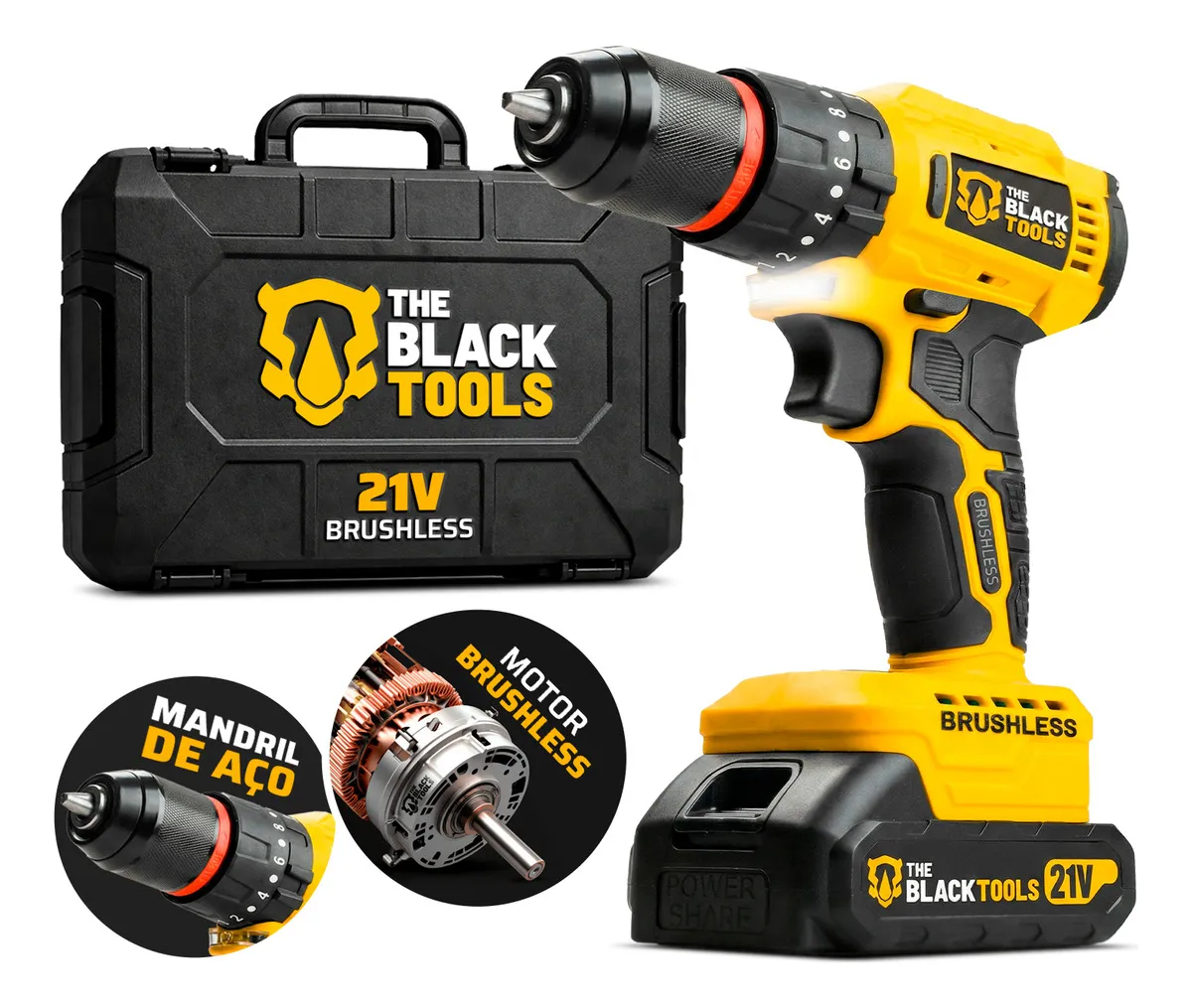
The The Black Tools TB-21B is aimed at buyers who want a cordless drill-driver with brushless efficiency, impact capability, and a practical kit format without stepping into oversized or overly specialized territory.
Yes, for the right user. The TB-21B makes the most sense if you want a versatile cordless tool for home projects, furniture assembly, general repairs, light installation work, and occasional drilling in tougher surfaces.
It is less convincing if you expect a heavy-duty replacement for larger 1/2-inch drills, long masonry sessions, or all-day professional abuse with no compromise in speed, battery endurance, or accessory range.
The The Black Tools TB-21B enters a very crowded category, and that is exactly why a review like this matters. Many cordless drill-drivers look similar on the surface, but small differences in chuck size, torque delivery, motor type, and kit focus can change the buying decision completely.
Here, the headline points are clear: brushless motor, 50 Nm torque, steel 3/8-inch chuck, impact function, and carry case. That combination suggests a tool designed to feel more capable than a basic entry model while still staying portable and approachable for everyday use.
What the The Black Tools TB-21B is built to handle
The TB-21B is positioned as a cordless impact drill-driver for mixed household and practical jobsite tasks. In plain terms, that means it is meant to cover fastening, pilot drilling, general drilling in common materials, and occasional harder applications where an impact function becomes useful.
The brushless motor matters because it changes how the tool is expected to behave over time. Compared with simpler brushed designs, a brushless setup usually points to better energy use, less internal wear, and a smoother balance between torque and control. That does not automatically make every brushless tool premium, but it is still a meaningful advantage in this category.
The 50 Nm torque figure places the TB-21B in a range that sounds strong for general-purpose use. That level is usually enough for driving long screws into wood, handling home improvement work, assisting with cabinetry or shelving, and taking on a wide mix of repair tasks without feeling underpowered too quickly.
The steel 3/8-inch chuck also gives the product a clear identity. It tells you this tool is built around mobility, convenience, and broad utility rather than maximum bit capacity. For many buyers, that is a smart compromise. For others, it is the exact point that will decide against it.
The chuck size and torque balance that decides the purchase
The biggest mistake in this category is assuming a drill-driver is better simply because the torque number looks good. In reality, the more important question is how that torque is paired with the chuck size, speed range, and the kind of work you actually plan to do.
On the TB-21B, the 3/8-inch chuck is both a strength and a limit. It is a strength because it keeps the tool in a more compact, more user-friendly segment. It tends to suit common bits, standard fastening jobs, home maintenance, and general drilling without making the drill feel too bulky in the hand.
It is a limit because buyers who want to run larger accessories, heavier masonry bits, or more aggressive hole-making setups will usually be better served by a 1/2-inch platform. That is especially true if the tool will be used for repeated demanding drilling rather than mixed everyday tasks.
This is where the TB-21B makes the most sense: it is not trying to be a specialist machine for every scenario. It is trying to be the one drill that covers most of what a typical buyer actually does. If your work falls into that zone, the specification sheet starts to look much more attractive.
The two-speed rotation range commonly associated with this model also reinforces that. A lower range is useful for controlled screwdriving and better start precision. A higher range helps when moving into straightforward drilling tasks. That kind of setup is practical, familiar, and more valuable in daily use than flashy claims that do not translate into better control.
Where the TB-21B feels most useful in real work
One of the most appealing things about this model is that it appears built around real-world versatility rather than a narrow one-task identity. That matters for buyers who do not want separate tools for every small project.
For furniture assembly, the TB-21B should feel much more relevant than a cheap screwdriver-style tool. The torque control gives better adjustment, the reversible function adds convenience, and the cordless format makes it easy to move between rooms or work areas.
For wall fixtures, shelving, light carpentry, and maintenance tasks, the tool seems well aligned with the kind of jobs people actually repeat. A drill-driver in this class can help with anchor preparation, bracket installation, minor workshop tasks, and general fastening without demanding advanced technique.
The impact function is another useful layer. It does not turn the TB-21B into a replacement for a dedicated rotary hammer, but it can make the drill more capable when the surface is less forgiving than plain wood or light metal. That matters for people who want one tool that can stretch further before they need something more specialized.
The steel chuck is also worth highlighting in practical terms. This is not just a spec-sheet detail. Buyers often notice chuck quality over time through grip consistency, bit stability, and general wear. A steel chuck suggests a more confidence-inspiring feel than the lighter-duty alternatives sometimes found in basic kits.
Extra convenience features usually matter more than expected too. Variable speed, torque settings, charge indicator, LED light, and a soft-grip handle do not sound dramatic on their own, but together they improve the everyday experience. That is especially true when the tool is used in tight corners, dim areas, or repetitive short tasks.
What may disappoint some buyers after the first week
The TB-21B looks strongest when it is judged as a versatile cordless drill-driver. It becomes less convincing when buyers project a heavier-duty role onto it than the product is really built for.
The first point of attention is the 3/8-inch chuck. For many users, it is more than enough. But for anyone expecting a broader range of larger accessories, that smaller chuck becomes the limiting factor quickly. This is not the tool to choose if your regular work already points toward bigger drilling demands.
The second point is that impact function often creates unrealistic expectations. An impact drill can expand what the tool can do, but it still does not replace a proper rotary hammer for repeated masonry work. If your projects involve hard surfaces week after week, a more purpose-built machine will make more sense.
Battery expectations also need to stay realistic. A cordless drill in this class can feel very convenient, but convenience is not the same thing as endless runtime. If your typical day involves long continuous drilling sessions, heavier fastening, or extended professional use without downtime, you may want a platform with larger battery options or a kit that includes more backup power from the start.
There is also the question of refinement. Buyers who are used to premium trade-focused cordless systems may notice that a tool like this is more about balanced value and broad usability than elite feel in every detail. That is not a flaw by itself, but it is a point worth understanding before buying.
Another detail to keep in mind is bundle variation. Tools in this category are often sold in slightly different kit combinations, so the safest way to judge the purchase is by the core machine and its confirmed characteristics, not by assuming every listing includes the same extras.
How the brushless motor and 50 Nm setup show up in use
When a drill-driver combines a brushless motor with 50 Nm torque, the promise is not just raw force. The real promise is better efficiency, steadier delivery, and more useful control across mixed tasks.
That is why the TB-21B looks strongest on jobs that alternate between fastening and drilling. It should feel capable enough for longer screws, practical enough for general assembly, and versatile enough to cover day-to-day repair work without needing constant tool changes.
The model is also commonly associated with a two-speed no-load range around 0-500 and 0-1280 RPM. In practical use, that kind of spread is good for buyers who want controlled starts at lower speed and more drilling pace when needed. It is not an extreme high-speed setup, but it is sensible for the type of tool this is.
The commonly cited 18+3 torque adjustment layout is another useful sign. It suggests a tool that is not only about strength, but also about dialing the output down when the material or fastener calls for more finesse. That matters when moving between delicate fittings, wood screws, brackets, or general installation work.
The battery platform tied to this model is also part of the story. A cordless 21V-format drill-driver is meant to feel capable without being tied to a cord, and that alone changes how often people reach for the tool. It becomes easier to use for quick repairs, faster to carry around, and more practical for people working across several small jobs instead of one large repetitive task.
Ergonomics matter here as well. A compact body, soft-grip contact points, and manageable weight make a bigger difference than many buyers realize. A drill can be technically strong but still unpleasant if it feels awkward during repeated use. The TB-21B seems designed to avoid that problem by staying in a more accessible size and handling profile.
Best fit for DIY users, repair work, and practical installations
The TB-21B makes the most sense for buyers who want one cordless drill-driver to cover a broad list of realistic needs. That includes homeowners, apartment users, hobbyists, furniture installers, light maintenance users, and anyone building a first serious cordless tool setup.
It is also a sensible match for people who want something beyond a basic household screwdriver but do not want to jump straight into a larger and heavier professional-duty platform. The brushless motor gives the model a more capable feel, while the 3/8-inch chuck keeps it from becoming unnecessarily bulky.
If your projects involve shelving, cabinets, curtain brackets, wall accessories, wooden structures, general repair work, metal drilling in lighter applications, or occasional harder surfaces, this tool fits the profile well. It also makes sense for users who care about portability and do not want a tool that feels oversized for simple jobs.
This is especially true if your buying priority is balance. The TB-21B looks like the kind of drill-driver that tries to sit between very basic kits and heavier trade-oriented machines. That middle ground is often exactly where the best everyday value lives.
When a different type of drill makes more sense
If your work regularly involves thick masonry, continuous hard drilling, or larger diameter accessories, it is smarter to move toward a heavier platform. In that scenario, the TB-21B may start to feel like a versatile backup rather than the ideal primary tool.
It also may not be the best choice for buyers who already know they prefer a 1/2-inch chuck. That preference is usually not random. It comes from the kind of bits, accessories, and workload those users handle. If that sounds like you, it is better to follow that need than to compromise early.
Another group that may want to look elsewhere is the buyer who mainly drives long structural fasteners and expects the feel of a dedicated impact driver. A drill-driver with impact capability can cover many situations, but it still serves a broader role than a tool built specifically for repeated aggressive fastening.
And if you already own a good all-purpose drill but need a second machine for specialized work, the TB-21B should only be chosen if it fills a clear gap. It is strongest as a main generalist tool, not as a replacement for every specialist machine in a serious workshop.
How it compares with other cordless options in the same lane
Against basic brushed drill-drivers, the TB-21B has an obvious appeal. The brushless motor alone makes it feel like a more modern and potentially more durable choice. Add the 50 Nm torque figure, steel chuck, and impact function, and it starts looking notably more complete than the most stripped-down starter kits.
Against compact 12V-class tools, the comparison changes. Smaller 12V tools often win on portability and comfort in very tight spaces, but they can lose ground when the job becomes more demanding. The TB-21B looks like the stronger pick for buyers who want one tool to stretch across more situations instead of prioritizing minimum size above everything else.
Against larger 1/2-inch drill-drivers, the TB-21B is more about convenience than maximum ceiling. Bigger tools usually make more sense for repeated heavy drilling, larger accessories, and more demanding professional use. The The Black Tools model is more attractive if you value portability and all-round usefulness over brute capacity.
Against combo-oriented kits loaded with many accessories, the key question is not quantity but focus. A long accessory list can look impressive, but the core machine still matters more. If the drill itself is well judged for your tasks, that matters more than extra filler items that may sit unused.
This is why the TB-21B appears strongest for buyers who want a straightforward cordless impact drill-driver with a useful spec mix rather than a kit designed mainly to impress at first glance.
Should the TB-21B be your next cordless drill?
If you want a cordless drill-driver that feels more serious than a basic home-use model, the TB-21B makes a convincing case. The brushless motor, 50 Nm torque, steel 3/8-inch chuck, impact function, and practical handling point to a tool built for real mixed use rather than occasional novelty.
It is a good fit when your shopping goal is simple: buy one drill that can assemble, fasten, repair, install, and drill across common materials without becoming too large or too specialized. It becomes a weaker fit when your work clearly demands larger accessories, longer heavy-duty sessions, or a more purpose-built masonry or fastening platform.
That makes the buying decision fairly clean. The TB-21B is not the best answer for every workshop, but it looks like a smart answer for a lot of everyday users.
Is the The Black Tools TB-21B good for home use?
Yes, it is a strong fit for home use. The combination of brushless motor, torque control, cordless convenience, and impact capability gives it enough flexibility for furniture, shelves, repairs, and common drilling jobs without feeling overly technical or oversized for casual users.
Can the TB-21B replace a rotary hammer for masonry work?
No, not as a full replacement. The impact function can help on tougher surfaces and light masonry situations, but repeated heavy drilling in hard walls is still better handled by a dedicated rotary hammer built specifically for that type of work.
Is a 3/8-inch chuck enough for most buyers?
Yes, for most general buyers it is enough. A 3/8-inch chuck covers common bits and typical household or workshop tasks well, but it is less attractive for users who already know they need larger accessories or more demanding drilling capacity on a regular basis.
Does the brushless motor make a real difference here?
Yes, it usually does. A brushless motor is associated with better efficiency, less internal wear, and more consistent performance, which makes the tool feel more modern and more suitable for repeated mixed-use work than a very basic brushed alternative.
Is the TB-21B better for drilling or screwdriving?
It is built to do both, which is part of its appeal. The lower speed range and torque adjustment help with controlled screwdriving, while the higher speed range and impact function give it enough flexibility for common drilling tasks across several everyday materials.
Who should skip this model?
Buyers who do frequent heavy masonry work, need a 1/2-inch chuck, or expect a dedicated impact driver feel for repetitive structural fastening should probably skip it. Those users will usually benefit more from a larger or more specialized cordless platform.
Does the TB-21B make sense as a first serious drill-driver?
Yes, it makes a lot of sense in that role. It offers a more capable spec mix than a basic entry-level tool, yet it still stays focused on practical versatility, which is exactly what many first-time buyers need from a cordless drill-driver.
The The Black Tools TB-21B stands out most as a balanced cordless impact drill-driver for people who want everyday usefulness with a stronger-than-basic feature set. If your work revolves around repairs, installations, furniture, wood, light metal, and general improvement tasks, it looks like a sensible buy. If your workload is already pushing into larger bits, harder masonry, or nonstop heavy-duty use, it is smarter to move up to a more specialized class.