A practical look at the Variall 1.5HP floating fountain aerator for fish ponds, tanks, lagoons and aquaculture systems where water movement and oxygen support matter every day.
The Variall 1.5HP Fountain Aerator makes sense for users who need stronger surface agitation, visible water circulation and oxygen support in ponds, fish tanks, rural reservoirs or small aquaculture setups. It is best suited to people who already have a suitable 220V installation, enough open water area and a real need for continuous or frequent aeration. It may not be the right choice for decorative ponds, very small tanks or buyers who need a silent, compact or low-power solution.
The Variall 1.5HP Fountain Aerator is aimed at a very specific problem: stagnant or poorly oxygenated water in environments with fish, organic load and constant biological activity. Instead of being a simple decorative fountain, it is positioned as a working aerator for pond and aquaculture use.
That distinction matters because buying an aerator only by power can lead to mistakes. A good choice depends on water volume, fish density, installation conditions, electricity availability, maintenance routine and how much circulation the pond actually needs.
What the Variall 1.5HP aerator is designed to do
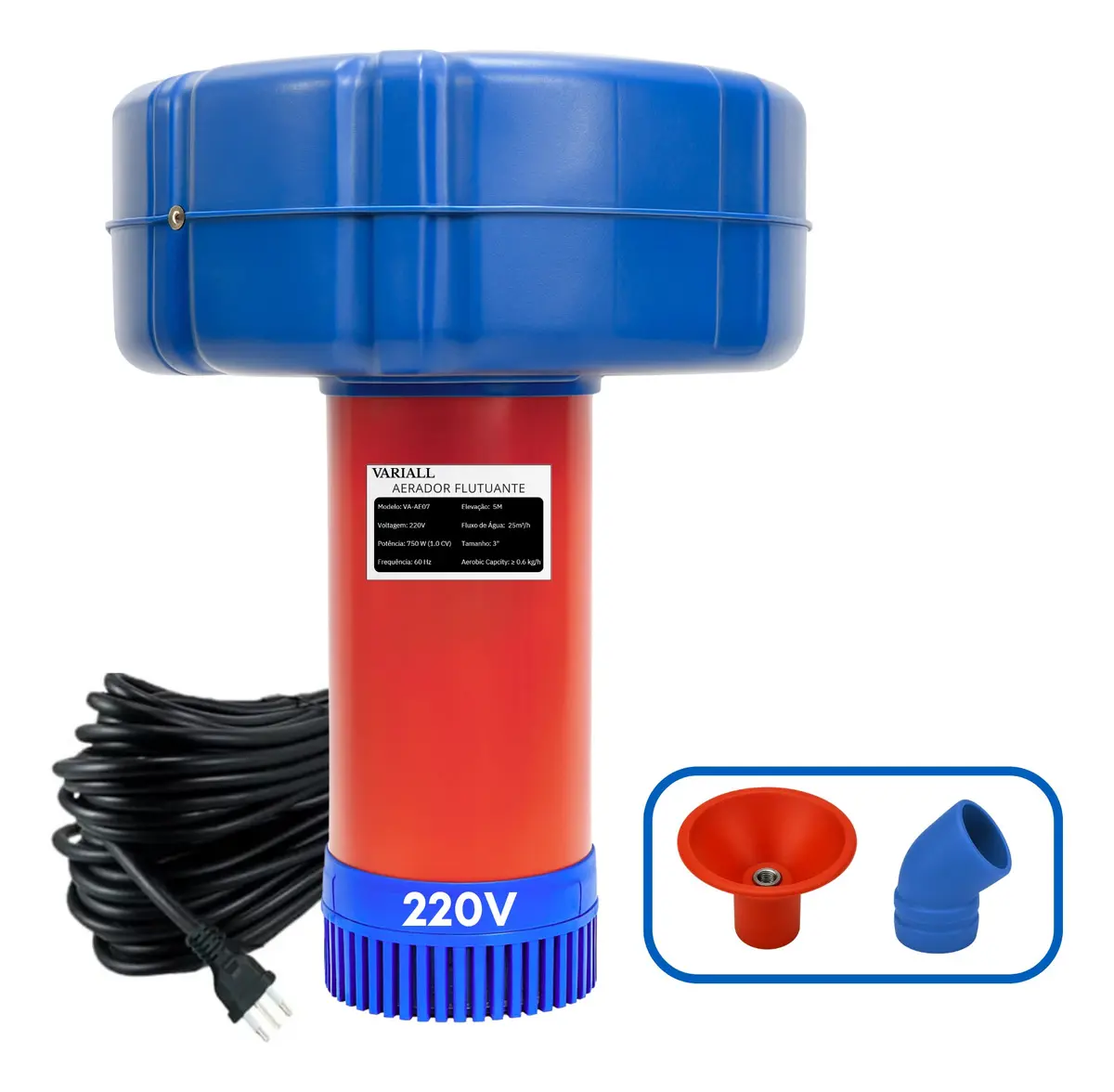
The Variall 1.5HP Fountain Aerator is a floating water aeration device built to move water at the surface and help increase oxygen exchange. Its fountain-style operation pulls water upward and spreads it back over the pond, creating agitation, circulation and a broader contact area between water and air.
The product is commonly presented as a 1.5HP, 1.1kW aerator with a floating structure, 220V operation and a long power cable. The listing also highlights a water flow of 15,000 liters per hour, which places it above small aquarium pumps and closer to practical pond and fish farming equipment.
Its most important role is not decoration, although the fountain effect can look pleasant. The real purpose is to support a healthier aquatic environment by helping reduce stagnant zones and improving water movement where fish, feed residues and organic matter can quickly affect water quality.
For fish ponds, tanks and lagoons, oxygenation is not only about keeping water visually active. Fish health, feeding response, stress level and survival can all be affected when dissolved oxygen becomes unstable, especially during hot weather, at night or in systems with higher stocking density.
This aerator fits the profile of users who need a robust, visible and relatively straightforward solution. It is not a laboratory-grade water management system, and it does not replace proper monitoring, filtration or pond management. Still, as a surface aerator, it can be a useful part of a broader water-quality strategy.
The biggest buying mistake with pond aerators
The most common mistake when choosing a fountain aerator is assuming that a stronger motor automatically solves every oxygen problem. Power matters, but it is only one part of the decision. The shape of the pond, the water depth, fish density, organic waste and operating schedule can change the real result.
A 1.5HP aerator can be too much for a very small decorative pond and not enough as the only solution for a heavily stocked production system. The right question is not only whether the unit is powerful, but whether its output matches the practical oxygen demand of the environment.
Another point of attention is electricity. This model is associated with 220V use, so the buyer must confirm that the installation site is compatible before purchase. Rural ponds, tanks and reservoirs often require safe electrical planning, weather protection, proper grounding and cable routing away from damage or accidental contact.
The long cable is useful because ponds rarely sit beside a convenient outlet. Even so, cable length alone does not eliminate the need for safe installation. Water, electricity and outdoor operation require care, especially if the unit will run for long periods.
It is also important to avoid treating the fountain effect as proof of complete oxygenation. Surface movement is a positive sign, but oxygen levels can still vary throughout the day. In more demanding fish farming environments, a dissolved oxygen meter remains the safer way to understand real pond conditions.
Where this aerator can help in daily use
The main benefit of the Variall 1.5HP Fountain Aerator is stronger water movement. In ponds with low circulation, surface agitation can help reduce stagnant areas and improve the exchange between air and water. That makes the environment more dynamic and less dependent on natural wind movement.
For fish farming, this can be especially useful during periods when oxygen demand rises. Warm water holds less oxygen, and fish consume more oxygen when feeding, growing or living in dense populations. An aerator helps create a more stable environment when natural oxygen renewal is not enough.
The floating design is also practical. A floating aerator is easier to position than many fixed systems, and it can be moved or adjusted according to the pond layout. This matters in rural use, where tanks and lagoons may not have perfectly regular shapes or permanent infrastructure.
The fountain-style movement also contributes to visual monitoring. When the unit is running, the user can immediately see water displacement. That does not replace technical measurement, but it does help identify whether the equipment is operating and whether the surface pattern looks normal.
Another advantage is versatility. The product is suitable for fish ponds, aquaculture tanks, artificial lakes and reservoirs where water circulation is desirable. It is not limited to ornamental use, and its specification profile points more toward functional aeration than simple landscape decoration.
For users managing fish, the best result usually comes when the aerator is part of a wider routine. Feed control, water renewal, sludge management, fish density and oxygen monitoring remain important. The aerator supports the system, but it should not be treated as the only safeguard.
What to consider before choosing this model
The first limitation is that this is not a small or discreet device. A 1.5HP fountain aerator is made for open water use, not for compact home aquariums or tiny ornamental ponds. Buyers expecting a subtle water feature may find it too strong or too operational in appearance.
Noise and splashing should also be considered. Fountain aerators create visible water movement, and that naturally produces sound and spray. In fish farming this is usually acceptable, but in a quiet residential garden it may be more noticeable than expected.
Another limitation is that the product does not remove the need for correct sizing. If the pond is too large, too deep, heavily stocked or poorly managed, one unit may not deliver the desired result by itself. In those cases, multiple aeration points or a different aeration strategy may be needed.
Maintenance is another practical factor. Any equipment operating in pond water can be exposed to organic matter, algae, suspended solids and debris. Regular inspection helps avoid performance loss, clogging, abnormal vibration or unnecessary strain on the motor.
The buyer should also check the installation details carefully. Voltage compatibility, cable routing, safe fixation and access for cleaning are not minor details. A powerful aerator installed poorly can create operational problems even when the equipment itself is suitable.
This model is better for users who understand that pond aeration is an operational decision. It can be a strong support tool, but it still requires responsible setup, observation and maintenance.
Power, flow and practical performance
The Variall 1.5HP Fountain Aerator is presented with 1.1kW power and a 1.5HP motor rating. This positions it in a more capable range than small decorative pumps, especially for users who need meaningful surface agitation in fish ponds or outdoor tanks.
The listed water flow of 15,000 liters per hour suggests a strong circulation profile for many small to medium pond applications. In practical terms, this means the unit is designed to move a significant amount of water continuously rather than only create a light fountain effect.
The 360-degree water movement is another relevant feature. A circular dispersion pattern can help spread agitation across the surface instead of directing flow to only one side. That is useful when the goal is more uniform surface disturbance around the aerator.
The long cable is also important for usability. A pond aerator often needs to sit away from the bank, and a short cable can make installation frustrating or unsafe. A longer cable gives more flexibility, although the final setup still needs to be protected and appropriate for outdoor use.
Because the product is associated with 220V operation, compatibility must be checked before purchase. This is especially important for rural properties where electrical infrastructure may vary. Using the wrong voltage or an improvised installation can damage equipment and create safety risks.
From a performance perspective, this aerator is best evaluated as a surface oxygenation and circulation tool. It helps move water, break surface stillness and support oxygen exchange. It does not guarantee perfect dissolved oxygen levels in every part of the pond, especially in complex or heavily loaded systems.
Best fit for fish ponds, tanks and rural water systems
This product is a strong match for people who keep fish in outdoor ponds, tanks or lagoons and need a practical way to improve surface aeration. It is especially relevant when the water tends to become still, warm, overloaded with organic matter or sensitive during feeding periods.
It also makes sense for small producers and rural users who want equipment with a more functional profile than a basic decorative pump. The combination of floating support, fountain-style movement, 1.5HP power and long cable points toward real pond management rather than purely ornamental use.
Owners of artificial lakes can also benefit when the goal is to create visible circulation and reduce stagnant surface areas. In these cases, the aerator may improve water movement and contribute to a more active aquatic environment.
The product is also suitable for users who want an aerator that is easy to understand. Its operation is straightforward: place it correctly, connect it safely and let it circulate water. That simplicity can be attractive for people who do not want a complex aeration system with multiple components.
It is most appealing when the buyer already knows the pond needs stronger oxygen support. If fish frequently gather near the surface, if water movement is weak or if oxygen risk is a recurring concern, a floating aerator like this can be a useful upgrade.
Cases where another solution may make more sense
This aerator is not the best choice for aquariums, very small tanks or decorative water features where low noise and subtle movement are priorities. In those cases, a smaller pump, air stone system or compact fountain may be more appropriate.
It may also be excessive for users who only want a visual fountain in a garden pond. The product’s appeal is its functional aeration capacity, not minimalist landscaping. If appearance is the main goal, a decorative fountain kit could provide a more refined visual result.
For very large, deep or intensively stocked systems, one unit may not be sufficient as the only aeration method. In professional aquaculture, aeration planning often requires multiple units, backup systems and oxygen monitoring. A single surface aerator should not be treated as a universal solution.
It may also frustrate buyers who cannot install 220V power safely near the pond. In outdoor water environments, the installation must be treated seriously. If the property does not support safe electrical setup, the buyer should solve that first or consider alternatives better suited to the available infrastructure.
Finally, this is not a maintenance-free product. Any pond aerator needs inspection, cleaning and occasional checks. Buyers who want a completely passive solution may underestimate the ongoing care required by outdoor water equipment.
How it compares with other pond aeration options
Compared with small submersible pumps, the Variall 1.5HP Fountain Aerator offers a stronger and more visible water movement profile. Small pumps can be useful for ornamental ponds, but they usually do not provide the same surface agitation expected from a floating pond aerator.
Compared with air compressors and diffusers, the difference is in the aeration method. Diffuser systems push air through underwater lines and can be useful for deeper oxygen distribution. A fountain aerator works mainly through surface agitation and water projection, which is easier to see and often simpler to deploy.
Compared with paddlewheel aerators, a fountain aerator may be more compact and visually central, while paddlewheel systems are often used in more intensive aquaculture setups. The right choice depends on pond design, water depth, stocking density and how the user wants to distribute movement.
Compared with decorative fountains, this model is more utilitarian. Its value is in circulation and oxygen support, not in refined landscaping effects. It can still improve the appearance of a pond by creating water movement, but that should be seen as a secondary benefit.
The Variall model fits buyers who want a balance between practical aeration, strong water movement and relatively direct installation. It is not the most discreet option and not the most specialized deep-water solution, but it can be a sensible middle ground for many pond and fish farming situations.
A clear buying decision for the right pond setup
The Variall 1.5HP Fountain Aerator is worth considering when the buyer needs a functional oxygenation tool for ponds, fish tanks or rural water systems. Its power rating, floating design, fountain-style movement and long cable make it more suitable for practical water management than for simple decoration.
It is strongest when used in environments where surface circulation is visibly needed and where installation conditions are already appropriate. It can support fish health, improve water movement and help reduce the risks associated with stagnant water.
The main caution is sizing. This is not a product to buy casually without considering pond volume, fish density, electricity, placement and maintenance. It works best when the buyer understands the environment and uses the aerator as part of a broader pond care routine.
For the right user, the value is straightforward: stronger movement, practical oxygen support and a design aimed at aquaculture and pond use. For the wrong user, especially someone with a small decorative pond or unsuitable electrical setup, it may be more equipment than necessary.
Is the Variall 1.5HP Fountain Aerator good for fish ponds?
Yes, it is suitable for fish ponds when the pond needs stronger surface movement and oxygen support. Its floating fountain-style operation is designed to circulate water and help improve air-water exchange. The best result depends on pond size, fish density, water quality and correct installation.
Can this aerator be used in aquaculture tanks?
Yes, it can be used in aquaculture tanks where the dimensions and electrical setup are compatible. It is most useful in systems that need visible surface agitation and continuous water movement. In more intensive production, it should be combined with oxygen monitoring and proper pond management.
Does the fountain effect mean the water is fully oxygenated?
No, the fountain effect shows that the water is moving, but it does not prove that oxygen levels are ideal everywhere. Dissolved oxygen can vary by time of day, temperature, fish load and organic matter. For production use, measuring oxygen remains the safest approach.
Is this model appropriate for small decorative ponds?
No, it may be too strong for very small decorative ponds. The Variall 1.5HP model is better suited to functional pond aeration, fish tanks and rural water systems. For small garden ponds, a compact decorative pump or smaller aerator may be more comfortable and visually balanced.
What should be checked before installation?
Voltage compatibility, cable positioning, safe electrical protection and pond placement should be checked before installation. Because the unit operates in an outdoor water environment, improvised wiring should be avoided. The aerator should be positioned where it can move water effectively and still be accessible for inspection.
Can it replace water quality management?
No, it should not replace complete water quality management. The aerator can support oxygen exchange and circulation, but feeding control, waste reduction, stocking density, water renewal and regular observation still matter. In fish farming, aeration is one part of a wider management routine.
Is the long cable useful in real pond use?
Yes, the long cable is useful because ponds and tanks are often located away from convenient power points. It gives more flexibility for positioning the floating aerator. Even so, cable routing must be done carefully to avoid damage, unsafe contact with water or exposure to traffic and animals.
Who will get the most value from this aerator?
Fish keepers, rural users and small aquaculture operators are the most likely to benefit. It is especially useful for people who need stronger surface circulation in ponds, tanks or lagoons. Buyers looking only for a quiet ornamental fountain may be better served by a smaller decorative solution.
The Variall 1.5HP Fountain Aerator is a practical choice for users who need real water movement and oxygen support in outdoor fish environments. Its strongest appeal is the combination of power, floating operation and fountain-style circulation for ponds, tanks and lagoons.
It should be chosen with a clear understanding of the pond’s needs, not only because the specification looks strong. When matched to the right environment and installed safely, it can become a useful part of a healthier and more stable aquatic system.