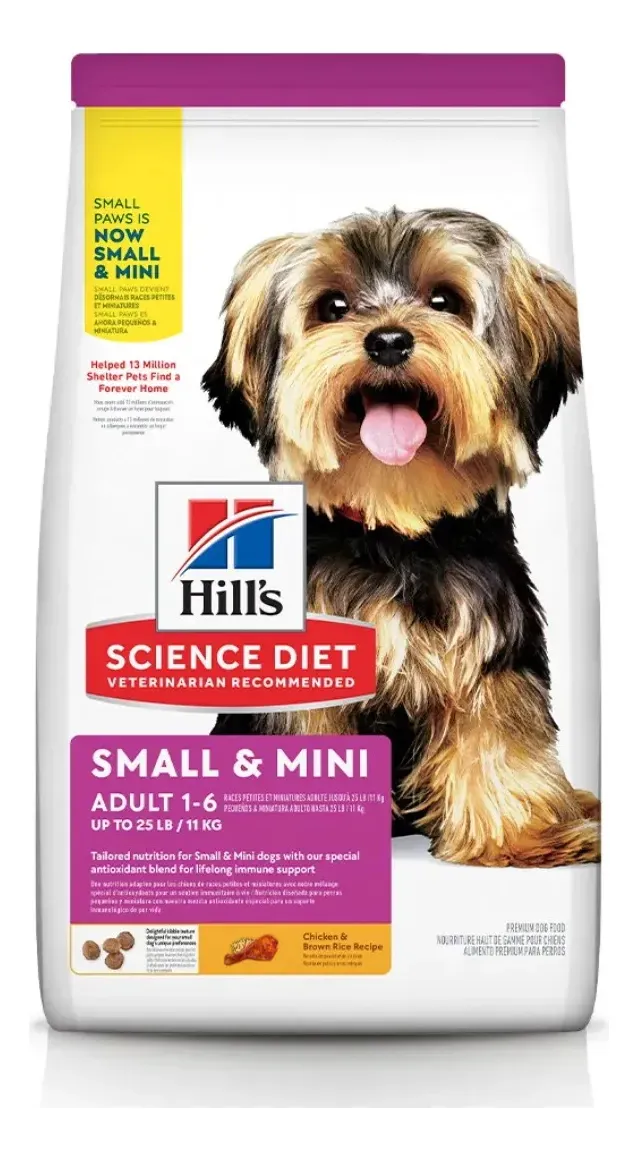
A practical look at Hill’s dry food for adult small and mini dogs, focusing on daily feeding, digestion, coat support, kibble fit, and when another formula may be the smarter choice.
Hill’s Science Diet Small & Mini Adult can make sense if you want a premium daily dry food designed specifically for adult small and mini dogs. Its strongest points are the small-dog focus, digestible ingredient profile, antioxidant support, omega-6 and vitamin E for coat care, and a kibble format made for smaller mouths. It is less suitable for puppies, senior dogs, large breeds, or dogs that need a veterinary therapeutic diet.
This Hill’s Science Diet Small & Mini Adult review is for owners who want a clear buying decision without guessing whether a standard adult dog food is enough for a smaller pet. Small dogs often have different feeding needs, not only because of body size, but also because of appetite, chewing comfort, stool quality, energy use, and tolerance during food changes.
The product is positioned as a complete dry food for adult small and mini dogs, with chicken as the main flavor direction and a formula built around balanced energy, digestible ingredients, immune support, skin and coat care, and daily maintenance. The key question is not whether it is a famous food, but whether its formula actually fits your dog’s routine.
What this Hill’s formula is built to do
Hill’s Science Diet Small & Mini Adult is a dry dog food made for adult dogs of small and mini size. It is not the same type of product as a general adult kibble for all breeds, because the proposal is more specific: support the daily needs of smaller dogs during their adult life stage.
The formula focuses on everyday maintenance rather than treating a diagnosed condition. That distinction matters. If your dog has kidney disease, obesity requiring clinical management, food allergy, chronic digestive problems, or another veterinary condition, this should not replace a diet recommended by a veterinarian.
For a healthy adult small dog, the appeal is more straightforward. The food is designed to provide balanced nutrition with ingredients that are easy to digest, a mix of proteins, fats and carbohydrates for daily energy, antioxidants for immune support, and nutrients associated with skin and coat health.
The chicken flavor direction also matters for palatability. Many small dogs are selective eaters, and a food that smells and tastes familiar may be easier to introduce. Still, palatability is individual. A dog can tolerate the formula well and still refuse it, especially if it is used to wet food, homemade meals, or highly aromatic snacks.
Another important point is the product’s identity as a small and mini dog formula. The kibble experience is part of the value. A smaller dog does not only need fewer calories; it also needs a food that feels manageable in the mouth and works with its chewing habits.
The small-dog detail that can decide the purchase
The biggest mistake in this category is choosing dog food only by brand reputation and ignoring the dog’s actual size, age, mouth, and routine. A small adult dog may struggle with a kibble that is too large, too hard, too greasy, or too rich for daily use.
Hill’s Science Diet Small & Mini Adult tries to solve that by focusing on small and mini breeds. The kibble is made for smaller dogs, which can help with chewing comfort and feeding acceptance. This is especially relevant for dogs that take food slowly, drop larger pieces, or prefer smaller textures.
Age is just as important as size. This food is aimed at adult dogs, not puppies and not senior dogs with age-specific needs. A puppy needs growth nutrition. A senior dog may need a formula adapted to aging, mobility, organ support, or lower activity levels. Using the wrong life-stage food can create an avoidable mismatch.
The transition period is another point that many owners underestimate. A sudden switch can cause loose stool, gas, refusal, or digestive discomfort even when the new food is good. A gradual transition is the safer approach, mixing the new food with the previous diet and increasing the new portion over several days.
For small dogs, portion discipline also matters. Because they eat smaller quantities, small measurement errors can become more meaningful. This food can fit well into a structured routine, but it still requires the owner to adjust the daily amount according to body condition, activity level, age, and veterinary guidance when needed.
Where the formula can help in daily feeding
The main advantage of this food is its practical focus on small adult dogs. Instead of using a broad formula for many breed sizes, it narrows the target to pets that need a more suitable kibble size and a nutrient profile aligned with smaller bodies.
Digestibility is one of the strongest decision points. The formula includes digestible ingredients and pumpkin, which can support stool quality and a more comfortable feeding routine. This does not mean it will solve every digestive issue, but it is a good sign for owners who care about daily tolerance.
Skin and coat support is another relevant part of the formula. Omega-6 and vitamin E are included for coat appearance and skin nourishment. For owners who notice dull coat, dry-looking fur, or inconsistent shine, this can be a meaningful feature, although results depend on the dog’s health, grooming, hydration, and overall routine.
The antioxidant blend is also part of the product’s positioning. For a daily adult food, immune support is useful because the goal is not just to fill the bowl, but to maintain the dog over time with a complete diet. This is where a better everyday formula can feel different from a basic option.
Protein support is another practical factor. The product is designed to help maintain lean muscle mass, which is important for small dogs that are active, playful, or naturally energetic. It is not a high-performance sports diet, but it aims to provide everyday adult maintenance.
The absence of artificial colors and flavorings is also positive for owners who prefer a cleaner daily feeding profile. It does not make the food automatically perfect for every dog, but it supports the idea of a more carefully formulated dry food.
What to check before changing your dog’s food
The first point of attention is sensitivity. The formula contains animal ingredients, grains, soy derivatives, corn derivatives, and other common components found in dry pet foods. For many dogs, this is not a problem. For dogs with known allergies or suspected food intolerance, it deserves closer evaluation.
If your dog has a history of itching, recurrent ear issues, vomiting, loose stool, chronic gas, or skin reactions after eating certain foods, do not choose only by popularity. A veterinary evaluation may be necessary to identify whether the dog needs a limited-ingredient food, a hydrolyzed diet, or another specific nutritional strategy.
This food also may not be the best match for owners looking for grain-free feeding. It includes grain-based ingredients such as rice, wheat, corn, sorghum, and related components. Grain-free is not automatically better, but if that is a strict requirement for your dog’s plan, this formula does not fit that preference.
Another point is that it is not a wet food and not a soft texture. Dogs with dental pain, missing teeth, chewing difficulty, or strong preference for moist food may resist dry kibble. In those cases, the issue is not only nutrition; it is also texture and eating comfort.
The formula is also not intended for large dogs. A large-breed adult has different feeding considerations, including kibble size, calorie density, and joint-related priorities. Choosing a small-dog formula for a larger pet would not be the most logical path.
Finally, this is not a prescription diet. Owners sometimes confuse premium daily nutrition with therapeutic nutrition. If a veterinarian has recommended a clinical formula, this product should not be used as a substitute unless the veterinarian confirms it is appropriate.
Formula details that influence everyday performance
The ingredient profile starts with chicken-derived ingredients and includes brown rice, wheat, corn, rice fragments, poultry meal, sorghum, chicken fat, soy bran, liver hydrolysates, flaxseed, pumpkin, vitamins, minerals, taurine, L-carnitine, beta-carotene, and natural preservative-related extracts.
This combination suggests a formula built around animal protein, digestible carbohydrates, fats for energy, fiber-related ingredients, micronutrients, and functional additions. For a small adult dog, that mix is intended to support daily energy, digestion, muscle maintenance, coat quality, and immune function.
The presence of pumpkin is interesting because it connects directly with digestive comfort and stool quality, two common concerns among owners of small dogs. It should not be treated as a cure for digestive disease, but it is a relevant ingredient in a daily food formula.
Flaxseed, omega-6 support, and vitamin E help explain the coat and skin angle. If your dog already has a healthy coat, the formula may help maintain it. If there is a medical skin problem, the food alone may not be enough.
Taurine and L-carnitine are also notable additions. They are commonly used in pet nutrition for broader metabolic and health support. Their presence reinforces that this is not a very basic dry food, but a more developed formula within the daily maintenance category.
Energy density is another practical factor. Small dogs can have active routines and fast metabolisms, but they also gain weight easily when portions are not controlled. The product’s daily amount should be adjusted carefully, especially for dogs that are neutered, less active, or prone to weight gain.
The type of dog that fits this formula best
This food is best aligned with healthy adult small and mini dogs that need a complete dry food for daily feeding. It makes the most sense when the owner wants a formula that is more specialized than a generic adult kibble and easier to match to a smaller dog’s mouth and routine.
It can be a strong option for dogs that do well with chicken-based food and do not have known sensitivity to grains or common dry food ingredients. It also fits owners who value digestive support, skin and coat nutrients, and an established premium-style formula.
It may be especially practical for dogs that eat dry food consistently and need a stable routine. Some small dogs become picky when their food changes often. A consistent formula can help create predictability, especially when portion control and feeding times are maintained.
Owners who want a dry food with no artificial colors or flavorings may also find it appealing. This is useful for daily feeding because the dog will consume the food repeatedly, not occasionally. A better everyday choice can have more impact than a treat or supplement used only sometimes.
The product also suits owners who want something simple to manage. Dry food is easier to store, measure, and serve than many fresh or wet alternatives. For busy households, that practicality matters, provided the dog drinks enough water and tolerates kibble well.
Cases where another diet may make more sense
This is not the right match for puppies. Growing dogs need food designed for development, not adult maintenance. A puppy may need different levels of energy, minerals, and growth-supporting nutrients, especially during the most active growth phase.
Senior dogs may also need a different formula. Some older small dogs need support for aging, mobility, digestion, organ function, or lower activity levels. If the dog is already showing age-related changes, a senior-specific food can be more appropriate.
Dogs with diagnosed health conditions need extra caution. Kidney issues, urinary problems, obesity under veterinary management, chronic gastrointestinal disease, food allergy, and other clinical situations may require a prescription or veterinarian-directed diet.
It also may not fit dogs whose owners want a grain-free recipe. This formula contains grains and grain derivatives. That does not make it poor quality, but it does mean it does not satisfy a grain-free preference.
Another diet may also be better if the dog needs a very specific protein source. Since this food is chicken-flavored and contains poultry-related ingredients, it may not work well for a dog that has shown sensitivity to chicken or poultry proteins.
Dogs that refuse dry food or have chewing discomfort may also need a different texture. In that case, forcing a dry kibble may not be the best solution. Wet food, mixed feeding, or veterinary dental evaluation may be more useful depending on the situation.
How it compares with other small-breed dry foods
Compared with basic adult dry foods, Hill’s Science Diet Small & Mini Adult has a clearer small-dog focus. That matters because a food made for all sizes may not always provide the same kibble experience, portion practicality, or small-breed positioning.
Compared with more economical everyday options, this formula leans toward a more developed nutritional proposal. The decision is not only about feeding a dog, but about choosing a daily food that emphasizes digestibility, coat care, immune support, and adult maintenance.
Compared with grain-free formulas, it takes a different path. It uses grains and other carbohydrate sources as part of the recipe. For many healthy dogs, that can be perfectly acceptable. For owners who strongly prefer grain-free feeding, this will not be the ideal match.
Compared with wet food, it is more practical for storage, measuring, and daily routine. Wet food may be more aromatic and easier for some dogs to chew, but dry food often wins on convenience and portion control. The right choice depends on the dog’s appetite, teeth, hydration, and owner routine.
Compared with veterinary therapeutic diets, this food is less specialized. That is not a weakness when feeding a healthy adult dog, but it is a decisive difference when the dog has a medical condition. Premium daily food and clinical nutrition are not the same category.
Compared with senior formulas, it is better suited to adult maintenance than age-related support. If your dog is still in the adult stage, active, and healthy, that focus can be appropriate. If your dog is older and slowing down, the comparison changes.
The practical decision before adding it to the routine
Hill’s Science Diet Small & Mini Adult is a good candidate for owners who want a reliable dry food for a healthy adult small or mini dog. Its value is in the combination of small-dog design, digestible ingredients, coat-related nutrients, antioxidant support, and practical daily feeding.
The strongest reason to choose it is fit. It fits small adult dogs better than many broad adult formulas. It also fits owners who prefer a dry food that is complete, structured, and easier to measure every day.
The strongest reason to pause is mismatch. If your dog is a puppy, senior, large breed, medically fragile, allergic to common ingredients, or dependent on a veterinarian-prescribed diet, this is not the most precise choice.
A careful transition is important. Even a well-formulated food can cause digestive disruption when introduced too quickly. Mixing it gradually with the previous food gives the dog’s system time to adapt and gives the owner time to observe stool, appetite, energy, and skin response.
If your dog is healthy, adult, small or mini, and already does well with dry chicken-based food, this formula is a strong option to consider. If there is any medical doubt, the smarter step is to confirm the feeding plan with a veterinarian before changing the bowl.
Is Hill’s Science Diet Small & Mini Adult good for small dogs?
Yes, it can be a good option for healthy adult small and mini dogs. The formula is designed for smaller breeds, with a kibble profile and nutrient balance aimed at daily adult maintenance. It is most suitable when the dog tolerates chicken-based dry food well and does not need a veterinary therapeutic diet.
Can puppies eat Hill’s Science Diet Small & Mini Adult?
No, puppies should generally eat a formula made for growth. This product is designed for adult maintenance, not puppy development. Puppies have different nutritional needs, especially for growth, energy, and mineral balance. If your dog is still growing, choose a puppy-specific food or follow veterinary guidance.
Does this food help with coat quality?
Yes, the formula includes omega-6 and vitamin E, which are associated with skin nourishment and coat appearance. It may help maintain a healthy-looking coat when the dog is otherwise healthy. If the dog has intense itching, hair loss, sores, or chronic skin problems, veterinary evaluation is more important than changing food alone.
Is Hill’s Science Diet Small & Mini Adult grain-free?
No, this formula is not grain-free. It includes grain-based ingredients such as rice, wheat, corn, and sorghum. That can be acceptable for many healthy dogs, but it will not fit owners who specifically want a grain-free diet or dogs with confirmed sensitivity to ingredients used in the recipe.
How should I switch my dog to this food?
Switch gradually by mixing the new food with the current food and increasing the new portion over several days. This helps reduce the chance of digestive upset. During the transition, watch stool quality, appetite, gas, vomiting, scratching, and energy level. If symptoms are strong or persistent, stop and consult a veterinarian.
Is this the same as a prescription dog food?
No, this is a daily adult maintenance food, not a prescription therapeutic diet. It is made for healthy adult small and mini dogs. If your dog has kidney disease, urinary issues, obesity treatment needs, allergies, chronic digestive trouble, or another medical condition, a veterinarian-directed formula may be necessary.
Can senior small dogs eat this formula?
It depends, but a senior-specific formula may be more appropriate for older dogs. Adult maintenance food can work for some mature dogs if they are healthy and active, but aging pets often need nutrition adapted to changing metabolism, mobility, digestion, or body condition. Veterinary advice is useful for older small dogs.
Is it suitable for picky eaters?
It may work for some picky eaters because it has a chicken flavor direction and a small-dog kibble format. However, taste preference is individual. Dogs used to wet food, homemade meals, or strong-smelling treats may resist dry food at first. A gradual transition and consistent feeding routine can improve acceptance.
Hill’s Science Diet Small & Mini Adult is most convincing when judged as a daily dry food for healthy adult small and mini dogs. It offers a focused small-breed proposal, practical kibble format, digestible ingredients, antioxidant support, and nutrients for skin and coat maintenance.
The decision is strongest when your dog is already in the adult stage, has no special medical diet requirement, tolerates common dry food ingredients, and needs a consistent formula for everyday feeding. It is less convincing when the dog needs age-specific, allergy-focused, grain-free, soft-texture, or therapeutic nutrition.
For the right small adult dog, it is a polished and sensible option. For the wrong profile, the smarter decision is not to force the fit, but to choose a formula that matches the dog’s age, health status, chewing comfort, and veterinary needs more precisely.