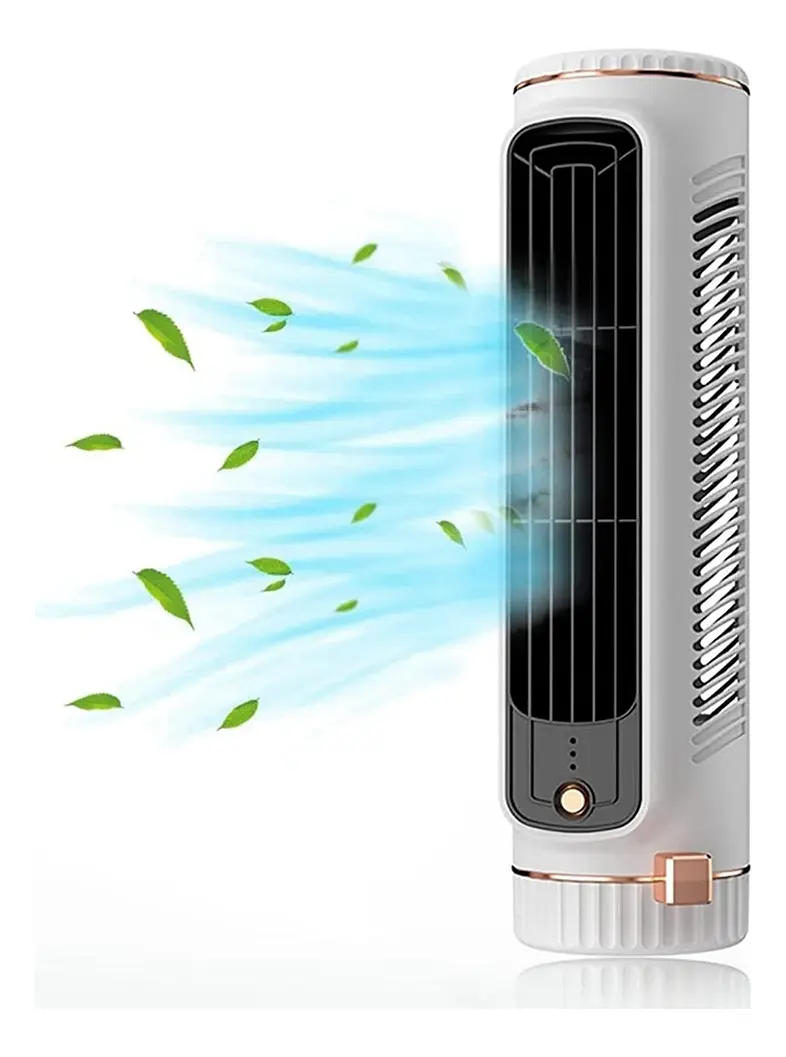
A compact USB cooling fan with a water tank, made for close-range comfort rather than replacing a full air conditioner.
The portable air conditioner fan makes sense if you want a small personal cooler for a desk, bedside table, study area, home office or very close-range use. It is not the right choice if you expect it to cool an entire room like a compressor-based air conditioner. Its real appeal is practicality: low energy use, compact size, simple operation and a softer airflow helped by water-based cooling.
This portable air conditioner fan review is for anyone who sees a compact cooling device online and wonders whether it is actually useful or just another small fan with a bigger name. The answer depends mainly on expectation.
Used at close range, this type of product can bring a more pleasant sensation than a basic mini fan, especially in dry heat or while working near a desk. Used as a replacement for real air conditioning, it will likely disappoint.
A small personal cooler, not a full room air conditioner
The product is best understood as a personal cooling fan with a water tank. It combines airflow with light evaporative cooling, which means the air passes through or around a damp cooling area before reaching the user. That can make the breeze feel fresher when the device is positioned close to the body.
This is different from a traditional air conditioner. A conventional air conditioner uses a refrigeration cycle, compressor and refrigerant gas to remove heat from the room. A compact USB cooler does not work that way. It does not extract heat from the entire environment, and it does not lower room temperature with the same authority.
The product is associated with a compact water tank, USB operation and low power consumption around 10 W. That puts it in the category of personal comfort devices rather than household climate-control equipment.
Its strongest use case is individual cooling. Think of a work desk, a bedside table, a small study corner, a gaming setup, a makeup area or a spot where you stay seated for long periods. In those situations, the short-distance airflow matters more than the ability to cool the whole room.
The device is also presented with humidifying and air-purifying claims. The humidifying role is easy to understand because of the water-based cooling system. The purifying role should be treated more carefully unless the exact filter type and replacement system are clearly confirmed. It is safer to see it as a fan with light humidifying support, not as a serious air purifier.
The biggest buying mistake is expecting room-level cooling
The main risk with a mini cooling fan like this is not the product concept itself. The risk is buying it with the wrong expectation. The name may suggest air conditioning, but the real performance profile is closer to a compact evaporative air cooler.
That distinction matters. A personal air cooler can make the air feel more comfortable when it blows directly toward you. It can help during work, study or rest when the heat is bothersome but not extreme. It can also be useful in spaces where using a large fan is inconvenient.
It should not be expected to cool a bedroom, living room or office on its own. It also should not be judged by the same standard as a portable air conditioner with an exhaust hose. Those are different products, built for different results.
Another point of attention is humidity. Evaporative cooling generally works better in drier conditions. In very humid environments, the cooling sensation may be weaker because the air already holds a lot of moisture. In that case, the product may feel more like a compact fan than a cooler.
This does not make it useless. It simply means the buyer needs to match the product to the right situation. If your goal is personal airflow with a fresher feel, it can make sense. If your goal is to transform a hot room into a cold room, it is not the best choice.
Where the compact format becomes genuinely useful
The strongest advantage is convenience. A USB portable air cooler is easy to place on a desk, shelf or nightstand, and it does not require the installation routine of a real air conditioner. That makes it attractive for renters, students, shared rooms and people who want a simple device for occasional comfort.
The low power profile is another practical point. A 10 W device is not designed for heavy climate control, but it is also not designed to consume energy like a large appliance. For close-range use, that balance can be appealing.
The water tank adds a different sensation from a basic fan. A standard fan only moves the surrounding air. This type of personal cooler can add a fresher and slightly more humid breeze, which may feel better when the air is dry or uncomfortable.
Its compact nature also helps in small routines. You can use it while reading, working on a laptop, doing skincare, sleeping near a bedside table or staying in a small corner that needs direct airflow. It is not made to serve everyone in the room at once.
The device also has a lower visual impact than a large fan. For people who dislike bulky appliances on a desk, a compact vertical cooler can be more discreet. That matters in home offices and small bedrooms where every bit of space counts.
Another benefit is simplicity. There is no complex setup, no wall installation and no need for an exhaust hose. The operation is closer to filling the tank, connecting the power source and adjusting the airflow. For buyers who want something uncomplicated, that is part of the appeal.
What can frustrate buyers after the first use
The product may frustrate people who expect a cold blast similar to a real air conditioner. Its airflow can feel fresher than a regular mini fan, but it is still limited by size, tank capacity, power and evaporative cooling behavior.
The water tank also requires attention. A compact tank is convenient, but it means the device depends on refilling for the cooling effect. When the tank is empty, the experience becomes closer to ordinary ventilation.
Another possible frustration is the reach of the airflow. Compact fans are most effective when placed near the user. If the device is far away, the cooling sensation becomes weaker. It is not the type of product to place in a corner and expect the whole room to change.
Noise perception can also vary. Small fans often produce a soft operating sound, but users sensitive to sound while sleeping should not assume it will be silent. For night use, the best experience usually comes from placing it at a comfortable distance and using the gentler speed setting when available.
The claimed air-purifying function deserves caution. Unless the exact filtration system is clearly specified, it should not be treated as a substitute for a dedicated air purifier. It may contribute to a fresher airflow sensation, but that is not the same as measured filtration performance.
Maintenance is another point to remember. Any device that uses water should be kept clean. Leaving water inside for long periods can create odor or residue. Regular emptying and cleaning help preserve the experience and reduce unpleasant smells.
Power, tank and everyday performance
The technical profile places this product in the compact personal cooler category. The key elements are USB power, a water reservoir and low wattage operation. These details are important because they explain both the convenience and the limits of the device.
USB operation is useful because it makes the product easier to place near laptops, adapters, power banks or desktop setups. It also reinforces the idea that this is a personal device, not a heavy appliance.
The water tank is central to the cooling sensation. A reservoir around 300 ml is enough for personal use sessions, but it is not large enough to behave like a high-capacity room cooler. That is why the product fits short-distance comfort better than long, whole-room cooling.
The 10 W power level also tells a lot about expected performance. It suggests efficient, lightweight operation, but not aggressive cooling. In practical terms, the device is more about improving comfort around the user than changing the climate of the space.
Performance will depend on ambient temperature, humidity, water temperature, distance from the user and airflow direction. The closer and more direct the airflow, the better the result. A small device like this should be positioned deliberately, not treated like a room appliance.
For the best experience, it makes sense to place it on a stable surface, keep the airflow aimed toward the upper body or face area, and maintain the tank clean. The device can feel more effective in a dry room, while humid spaces may reduce the cooling effect.
Best fit for desk, bedside and personal routines
This compact cooler is most suitable for people who want a small comfort upgrade in a fixed personal spot. It fits users who spend time at a computer, study table, craft desk, reception counter or bedside area.
It also makes sense for those who cannot install air conditioning or do not want to use a larger appliance for one person. In that case, the product works as a targeted solution: it cools the person, not the room.
People who feel uncomfortable with dry air may also appreciate the humidifying aspect. The breeze can feel softer than the airflow from a basic fan, especially when the tank is filled and the device is used nearby.
It may also appeal to anyone looking for a compact device for secondary spaces. A home office, dorm room, small bedroom corner or temporary work area can be a better match than a large open living room.
The product is also a reasonable option for buyers who prioritize portability, simplicity and low energy use over raw cooling power. It is a practical comfort device, not a technical climate-control solution.
Cases where another cooling option makes more sense
This is not the ideal product for large rooms, very hot environments or users who expect strong temperature reduction. In those cases, a traditional fan, a larger evaporative cooler or a real portable air conditioner may be more appropriate.
It is also not the best choice for someone who wants cooling for multiple people at once. The airflow is personal. It works best when one person is near it and the breeze is directed properly.
Buyers in very humid regions should be especially realistic. Since evaporative cooling depends on moisture interaction with the air, humid conditions can reduce the fresher sensation. The product may still ventilate, but the cooling effect may feel less noticeable.
People with high expectations for air purification should also look elsewhere. Without clear information about filtration grade, filter replacement and purification capacity, it should not be chosen mainly for air-quality treatment.
It may also be a poor fit for anyone who dislikes refilling water tanks or cleaning small appliances. The product is simple, but water-based devices always require basic care.
How it compares with fans, larger coolers and real air conditioners
Compared with a basic mini fan, this portable air conditioner fan offers a more versatile comfort experience because of the water tank. The breeze can feel fresher and less dry. For close-range use, that makes it more pleasant than simple airflow in some situations.
Compared with a full-size fan, it is less powerful but more compact. A large fan moves more air and can serve a bigger area. The compact cooler is better for one person who wants direct airflow without taking much space.
Compared with a larger evaporative cooler, it is easier to place and simpler to handle, but it has less reach and lower capacity. A bigger cooler is more suitable for longer sessions and larger spaces. The mini model is better when portability matters more than coverage.
Compared with a portable air conditioner with an exhaust hose, it is much simpler and lighter, but also far less powerful. A real portable air conditioner can lower room temperature because it removes heat from the space. This compact product mainly improves the sensation of comfort near the user.
That comparison helps define the purchase. Choose this type of device for personal cooling, desk comfort, low energy use and easy placement. Choose a stronger appliance if the priority is room-level temperature control.
The practical decision comes down to expectation
The portable air conditioner fan is a good match when the buyer understands its category. It is a compact personal cooling fan with water-assisted airflow, not a replacement for an installed air conditioner.
Its value is in convenience, not power. It can make work, study or rest more comfortable when positioned close to the user. It is especially relevant for people who want a small device that is easy to move, simple to use and suitable for personal spaces.
The product becomes less convincing when judged as a room cooler. The compact tank, USB power and low wattage are not flaws by themselves; they simply show what the product is designed to do. It is built for personal comfort, not full-room climate control.
If your expectation is realistic, the product can be a useful small appliance for hot days. If your expectation is cold-room performance, a different category will be the wiser choice.
Does this portable air conditioner fan really cool the air?
Yes, but only in a limited personal way. It can make the airflow feel cooler by using water-assisted ventilation, especially when placed close to you. It should not be expected to reduce the temperature of an entire room like a compressor-based air conditioner.
Can it replace a regular air conditioner?
No, it should not be treated as a replacement for a regular air conditioner. A real air conditioner removes heat from the room through a refrigeration system. This compact device is better understood as a personal air cooler for direct, close-range comfort.
Is it good for a bedroom?
Yes, it can be useful in a bedroom if used near the bed or on a nightstand. It is better for one person than for the whole room. Light sleepers should consider fan noise and use the gentler setting when they want a calmer night routine.
Does the water tank make a noticeable difference?
Yes, the water tank can make the breeze feel fresher than a simple mini fan. The effect depends on humidity, room temperature and how close the device is to you. In very humid environments, the difference may feel less strong.
Is it suitable for a home office desk?
Yes, a home office desk is one of the best places for this type of product. The compact size, USB power and direct airflow match seated use very well. It works best when placed nearby and aimed toward the user.
Does it purify the air like a real air purifier?
No, it should not be chosen as a replacement for a dedicated air purifier. Although the product may be described with purifying functions, serious air purification depends on specific filters and measurable filtration performance. Its main role is cooling sensation and airflow.
Is it better than a normal fan?
Yes, it can be better than a normal mini fan if you want a softer, fresher airflow from a compact device. A larger fan will still move more air across a wider space. The advantage here is personal comfort in a small area.
Who will be disappointed by this product?
People expecting strong room cooling will likely be disappointed. This product is not designed to cool large spaces, serve several people at once or replace a full air-conditioning system. It works best for realistic buyers who want close-range comfort.
The portable air conditioner fan is worth considering when the goal is simple personal cooling. It is compact, easy to place, low-power and more comfortable than a basic mini fan when the water-assisted airflow is used properly.
The safest way to evaluate it is to think of it as a desk and bedside comfort device. It can improve the feeling of heat around one person, but it should not be expected to transform the temperature of a full room.
For users who want a practical device for work, study, reading or sleeping nearby, it can be a smart small upgrade. For users who need strong cooling, wide coverage or real air-conditioning performance, a more powerful appliance will be the better path.