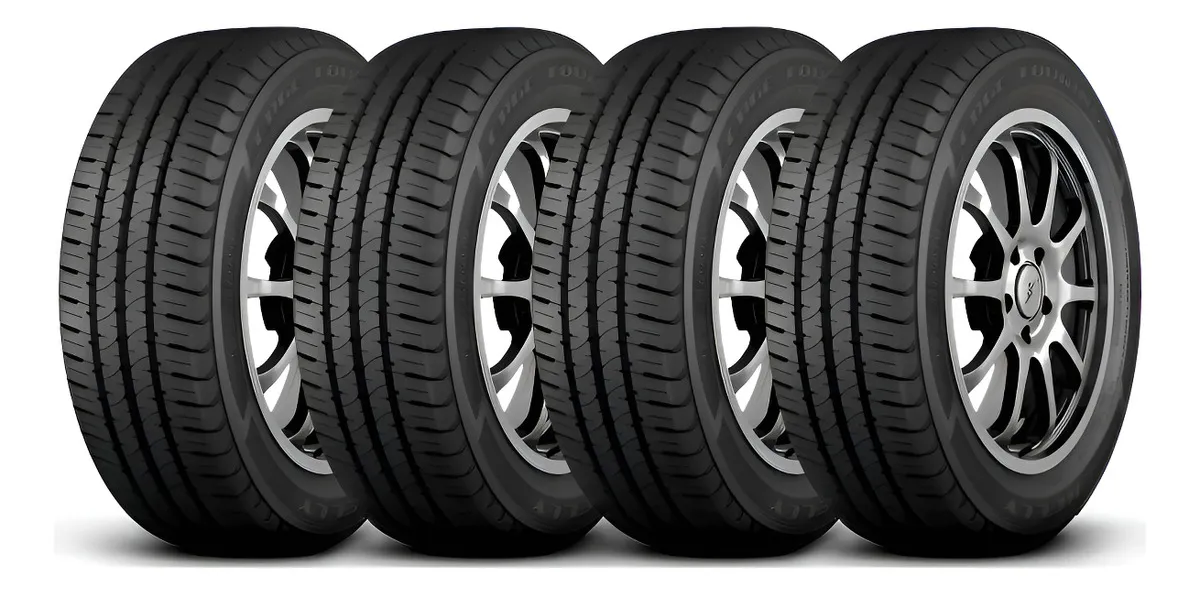
A practical everyday tire set for drivers who want comfort, predictable handling and a trusted brand name in a compact-car size.
The Kelly Edge Touring 2 175/70R13 82T is worth considering if your car originally uses this size and you want a balanced four-tire replacement for city driving, occasional highway use and routine family mobility. It makes the most sense for drivers who value comfort, steady grip and durability over sporty response, off-road capability or high-performance driving.
The biggest question with a tire like the Kelly Edge Touring 2 is not whether it looks attractive on paper, but whether it fits the way the car is actually used. In this size, the product is aimed at compact vehicles that need a reliable touring tire rather than an aggressive performance option.
This kit is also appealing because it replaces all four tires at once, which helps keep the vehicle more balanced in braking, steering and ride comfort. Still, the decision should start with compatibility: the tire size, load index and speed index must match what the vehicle manufacturer recommends.
What the Kelly Edge Touring 2 is built to do
The Kelly Edge Touring 2 in 175/70R13 82T is a passenger tire designed for cars and light everyday use. It uses radial construction, a symmetric tread pattern and a non-directional layout, which makes it straightforward for regular installation and routine rotation when done by a qualified tire shop.
The 175/70R13 size tells you three important things. The tread section width is 175 mm, the sidewall height is 70 percent of that width, and the tire fits a 13-inch wheel. This is a common profile for smaller and older compact cars, where comfort, simple maintenance and predictable behavior matter more than sporty cornering.
The 82T rating is also important. The load index 82 indicates a maximum load rating of 475 kg per tire, while the T speed rating corresponds to a maximum rated speed of 190 km/h under proper conditions. These numbers are not a recommendation to drive at the limit; they are compatibility references for the vehicle and tire structure.
The product is positioned as an all-season, HT-style tire for paved-road use. In practical terms, it is better understood as a daily asphalt tire for urban routes, commutes, errands and occasional road trips. It is not the right choice for drivers who need a tire focused on mud, snow, ice or aggressive terrain.
The fitment mistake that matters most with 175/70R13 tires
The most common error when buying a tire in this category is choosing only by brand or visual appearance and ignoring the original tire specification of the vehicle. The Kelly Edge Touring 2 may be a good match for many compact cars, but only if 175/70R13 82T is compatible with the car’s wheel, suspension setup and manufacturer recommendation.
A tire with the wrong size can affect speedometer reading, ground clearance, steering response, braking behavior and body clearance. Even a small change can create rubbing, irregular wear or a different driving feel. That is why the tire size printed on the current tire, the vehicle manual and the door-frame label should be checked before purchase.
The load index also should not be treated casually. If the car requires a higher load rating, moving down is not advisable. The same applies to speed rating: using a lower specification than recommended may compromise safety margins and may not meet the vehicle’s original requirement.
This is especially relevant for a four-tire kit. Replacing all four tires can be excellent for balance, but only when the chosen specification is correct from the start. If the size is wrong, the error affects the entire set rather than only one axle.
Daily comfort, grip and road behavior
The main strength of the Kelly Edge Touring 2 is its practical touring character. It is not trying to be a sporty tire, and that is part of its appeal. The sidewall profile and tread proposal are more aligned with comfort, predictable steering and stable everyday driving.
For city use, the tire should suit drivers who face mixed pavement quality, speed bumps, short commutes and frequent stop-and-go traffic. The 70-profile sidewall helps preserve some cushioning compared with lower-profile tires, which can be useful in places where the road surface is not always smooth.
The tread is described with a focus on durability, contact area and reduced localized wear. In real-world decision terms, that makes it more attractive for people who want a tire that feels consistent over time rather than one that prioritizes sharper cornering or a more aggressive road feel.
Wet-road confidence is another key factor for this category. The Kelly Edge Touring 2 carries a traction rating of A, and its tread includes grooves intended to help channel water away from the contact patch. That does not eliminate aquaplaning risk, but it supports the tire’s role as a sensible daily-use option for paved roads.
Noise is also part of the comfort equation. The tire is listed with external noise reduction and a 73 dBA external noise level. That does not guarantee a silent cabin, because vehicle insulation, pavement texture and tire pressure also matter, but it points to a tire designed with everyday refinement in mind.
Where the compromise can appear
The Kelly Edge Touring 2 is strongest as a balanced daily tire, not as a specialist tire. Drivers expecting sharp steering, high-speed sportiness or premium luxury refinement may find it more conservative than exciting. That is not necessarily a flaw; it is the natural trade-off of a touring tire in this size.
Another point to keep realistic is fuel efficiency. The tire is promoted around economy and smooth rolling, but the listed fuel-efficiency classification is F. For the buyer, that means it is better to view economy as part of the tire’s overall proposal, not as the strongest measurable reason to choose it.
It is also not a run-flat tire. If a puncture causes air loss, the driver should not expect the reinforced mobility of a run-flat product. Keeping the spare tire, repair kit or roadside assistance plan in order remains important.
The tire is not listed as suitable for snow or ice grip. It may carry an all-season positioning, but that should not be confused with a dedicated winter tire. For cold climates, snow routes or mountain conditions, a more specialized tire would be the safer direction.
Finally, the HT and paved-road profile means it is not meant for off-road use. Gravel access roads may be unavoidable in normal life, but this is not the tire to choose for repeated dirt-road abuse, mud, construction-site use or rough rural terrain.
The technical profile behind the ride
The core specification is 175/70R13 with a 13-inch rim diameter and 175 mm section width. The aspect ratio of 70 gives it a taller sidewall than many modern low-profile tires, which generally helps comfort and impact absorption in daily driving.
The tire uses radial construction, which is the standard architecture for modern passenger-car tires. Its symmetric tread and non-directional layout are practical for maintenance because they do not impose the same directional mounting constraints as directional tires.
The UTQG rating is 340AB. The treadwear figure of 340 suggests a tire positioned for reasonable durability within its category, while the A traction rating is a positive sign for grip classification. The B temperature rating is adequate for its intended everyday-use profile.
The tread depth is listed at 6.9 mm. That gives a useful starting point for normal use, but long-term performance depends heavily on alignment, rotation, inflation pressure, driving style and suspension condition. A good tire can wear poorly if the vehicle is misaligned or driven with incorrect pressure.
The maximum load rating is 475 kg per tire, and the speed rating is T. These specifications should be checked against the vehicle’s original requirement. If the car’s manual calls for the same or a lower minimum rating, the tire can be considered within that specification; if the car requires more, it should not be forced into the application.
The sidewall is BSW, meaning a black sidewall appearance. That keeps the visual style simple and conventional, which fits the product’s everyday touring identity. It is not a tire chosen for visual customization; it is chosen for practical replacement.
Drivers who will get the best match from this tire
This tire makes the most sense for drivers of compact cars who want a complete replacement set and use the vehicle mainly on paved roads. It is especially suitable for daily commutes, school runs, errands, city traffic and occasional highway travel.
It also fits buyers who prefer a recognized tire group rather than an unknown budget option. Kelly is associated with Goodyear, and that adds confidence for people who want a familiar name without necessarily moving into the most premium touring lines.
The four-tire kit format is useful for anyone whose current tires are worn as a set or unevenly aged. Replacing all four tires can improve consistency between front and rear axles, reduce mixed-grip behavior and make the car feel more predictable.
It is also a sensible match for drivers who do not want to overcomplicate the purchase. The tire is not packed with exotic positioning or specialist promises. It offers a straightforward profile: compact-car size, touring use, everyday grip, comfort and durability focus.
When another tire profile is the smarter move
This is not the strongest choice for performance-focused drivers. If the priority is sharper steering, more aggressive cornering, higher-speed stability or a sportier feel, a performance-oriented tire in the correct size would be more appropriate.
It is also not ideal for drivers who frequently travel on rough dirt roads or work in environments where tires face stones, mud and repeated impacts. In that case, a tire with a more robust terrain-oriented design would make more sense.
Drivers in regions with snow or icy roads should also look elsewhere. The Kelly Edge Touring 2 is not presented as a snow or ice tire, and using an everyday all-season tire in those conditions can create unrealistic expectations.
Another situation to avoid is buying it for a car that does not use 175/70R13 as an approved size. Even if the tire seems attractive, fitment comes first. A good tire in the wrong size is still the wrong tire.
How it compares with other everyday 13-inch tire choices
Compared with very basic entry-level tires, the Kelly Edge Touring 2 offers a more reassuring proposal because of its brand association, touring focus and strong buyer feedback. It is a safer editorial choice for drivers who want balance rather than simply the most basic replacement possible.
Compared with premium touring tires, it may not deliver the same level of refinement, wet braking sophistication or cabin quietness that more expensive-positioned lines often emphasize. Its role is not to dominate every category, but to offer a credible middle-ground solution for compact cars.
Against sportier alternatives, the Kelly Edge Touring 2 is more comfort-oriented. That makes it better for routine driving but less attractive for anyone who wants a firmer, more responsive feel through corners. The taller sidewall helps comfort, but it will not feel as direct as a lower-profile performance tire.
Against reinforced or rough-use tires, it is clearly more urban. The HT and all-season paved-road profile favors asphalt, not repeated abuse on unpaved routes. That makes it a better match for city and road use than for demanding rural conditions.
The strongest comparison point is balance. This tire is not the most specialized option, but it covers the everyday needs that matter to many compact-car owners: correct sizing, comfort, predictable grip, practical maintenance and a familiar manufacturer association.
The buying decision for city and highway use
The Kelly Edge Touring 2 175/70R13 82T is a strong candidate if your vehicle requires this size and your driving routine is mostly urban with occasional road trips. It offers a practical blend of comfort, durability focus and predictable paved-road behavior.
The decision becomes even stronger if your current tires are worn unevenly or if you want to restore balanced grip across all four corners of the vehicle. A matched set can help the car feel more stable than mixing old and new tires from different models.
The tire becomes less convincing if you need sport performance, winter traction, off-road resistance or a higher technical specification than 82T. It should be chosen because it matches the car and driving profile, not simply because it is a recognizable name.
For a compact car that uses 175/70R13, this kit is a practical and sensible option. It is best viewed as a dependable daily-use tire set for drivers who want comfort, straightforward handling and a trusted touring proposal without moving into a specialist tire category.
Is the Kelly Edge Touring 2 175/70R13 good for highway driving?
Yes, it can be a good match for occasional highway driving when the tire size and 82T rating are approved for the vehicle. Its touring profile is designed for paved-road stability and everyday comfort. It is not a sport tire, so drivers expecting aggressive high-speed response should consider a more performance-focused alternative.
Can I use this tire on any car with 13-inch wheels?
No, the wheel diameter alone is not enough to confirm compatibility. The vehicle must be approved for 175/70R13 tires, and the load and speed rating must meet the manufacturer’s requirement. Check the current tire, the vehicle manual and the tire information label before installing a full set.
Is the Kelly Edge Touring 2 a quiet tire?
Yes, it is positioned with noise reduction and an external noise level of 73 dBA, which supports its everyday comfort proposal. Cabin noise can still vary depending on pavement, vehicle insulation, inflation pressure and suspension condition. It should be seen as a comfort-oriented tire, not a guaranteed silent tire in every car.
Does this tire work well in rain?
Yes, it has a traction rating of A and tread grooves designed to help manage water on paved roads. That supports safer wet-road behavior when the tire is properly inflated and not worn out. It still requires cautious driving in heavy rain because no tire fully prevents aquaplaning in poor conditions.
Is this a run-flat tire?
No, the Kelly Edge Touring 2 in this specification is not a run-flat tire. If it loses pressure after a puncture, it should not be driven as if it had reinforced run-flat mobility. Keeping the vehicle’s spare tire, repair solution or roadside assistance option available remains important.
Is this tire suitable for snow or ice?
No, it is not presented as a snow or ice tire. Its all-season positioning is better understood as a practical paved-road profile for normal weather conditions. For regular snow, ice or very cold-weather driving, a dedicated winter tire with the correct vehicle specification would be a safer choice.
Why choose a four-tire kit instead of replacing only two tires?
A four-tire kit can make sense when all tires are worn, aged or mismatched. Replacing the full set helps keep grip, tread depth and road behavior more consistent across the vehicle. If only two tires are replaced, professional guidance is important to decide axle placement and preserve stability.
What should I check before installing the Kelly Edge Touring 2?
Check the approved tire size, load index, speed index, wheel condition and valve condition before installation. After mounting, the car should have correct balancing and proper tire pressure. If the previous tires showed uneven wear, alignment and suspension inspection are also important to protect the new set.
The Kelly Edge Touring 2 175/70R13 82T is a dependable everyday tire kit for compact cars that use this exact specification. Its best qualities are practical comfort, predictable paved-road behavior, straightforward maintenance and a touring profile that suits normal city and road use.
It is not the tire for every driver. It should not be chosen for sport driving, off-road use, snow, ice or vehicles that require another size or higher specification. But for the right compact car and the right daily routine, it is a balanced replacement set that keeps the decision simple and sensible.