A practical look at a pressurized pond filter with UV-C support for owners who want clearer water, easier maintenance and a cleaner-looking garden pond setup.
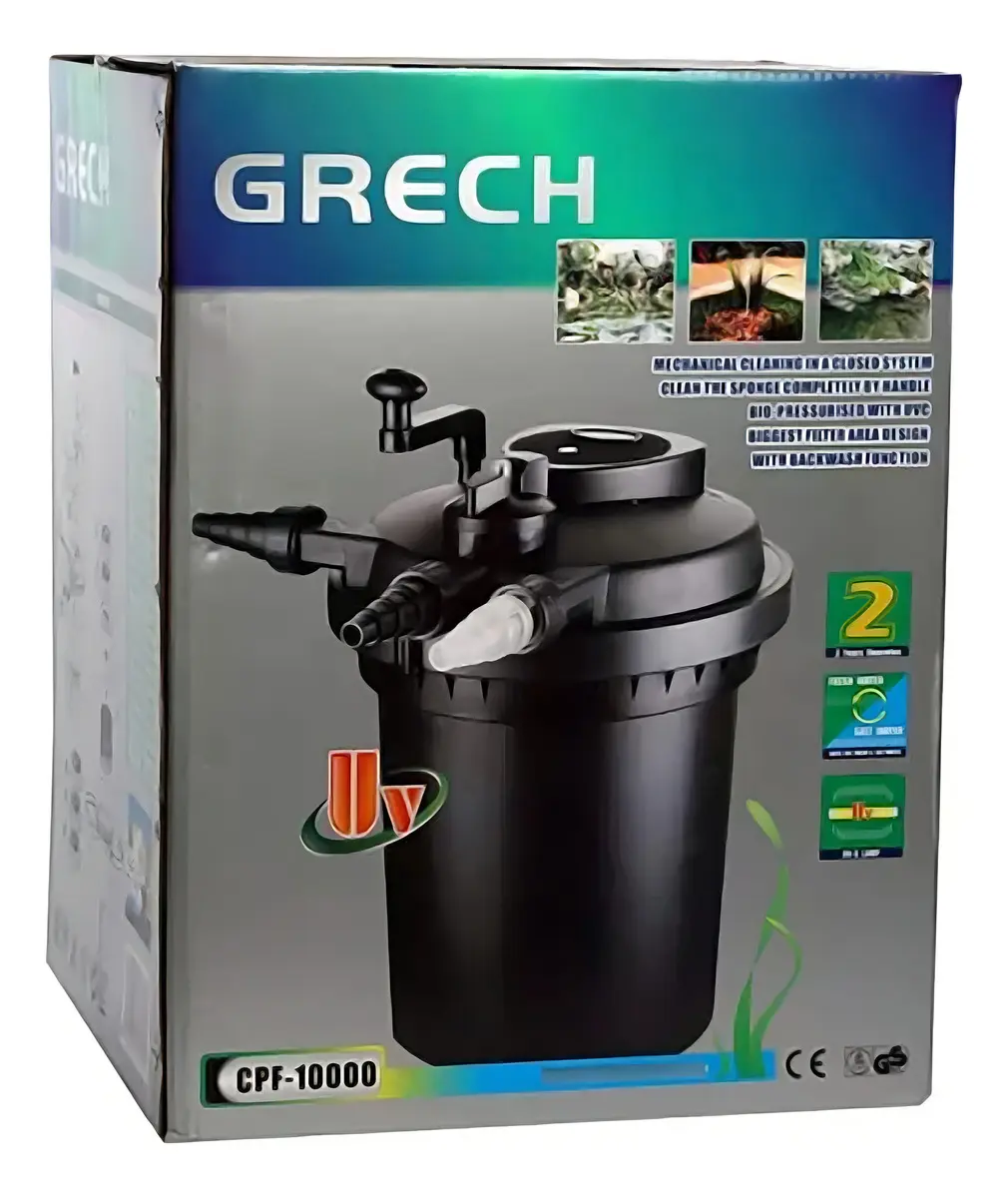
The SunSun CPF-10000 is a good choice if you need a pressurized pond filter for a medium to large ornamental pond and want mechanical filtration, biological support and UV-C clarification in one unit. It makes most sense for users who already have, or plan to use, a compatible pond pump and want a more organized filtration setup without building a custom filter system.
This SunSun CPF-10000 review is for anyone trying to understand whether this filter is enough for a pond in the 10,000-liter class, especially when the water gets green, cloudy or difficult to keep visually clean.
The most important point is simple: this is not just a box that catches dirt. It is a pressurized pond filter with an integrated UV-C lamp, so the buying decision depends on pond volume, fish load, pump compatibility, maintenance habits and expectations about water clarity.
What the SunSun CPF-10000 is designed to do
The SunSun CPF-10000 is a pressurized filter for garden ponds, ornamental lakes and outdoor aquatic setups where water needs to pass through filtration media before returning to the pond. Its main purpose is to help reduce suspended debris, support biological filtration and improve water clarity with the help of UV-C light.
Because it is pressurized, it is different from a simple open filter box. Water is pushed into the unit by a pond pump, passes through the internal filtration stages and then exits back toward the pond, waterfall, stream or return outlet, depending on how the system is installed.
The integrated UV-C lamp is one of the key reasons people consider this model. UV-C clarification is especially useful when the main complaint is green water caused by suspended algae. It does not replace proper filtration, but it can help improve visual clarity when the flow rate, pond size and maintenance routine are appropriate.
This model is commonly positioned for ponds around the 10,000-liter range. That does not mean every pond with that volume will behave the same. A lightly stocked decorative pond is easier to manage than a heavily stocked fish pond with direct sun exposure, organic waste, leaves and frequent feeding.
The strongest appeal of the CPF-10000 is convenience. It combines multiple functions in one unit and is designed for users who want a practical pond filter rather than a fully custom filtration build. That makes it attractive for homeowners, hobbyists and small garden pond owners who want clearer water without making the filtration system visually dominant.
Pond size is where many buyers make the wrong call
The biggest mistake with a filter like the SunSun CPF-10000 is choosing it only by the advertised pond volume. Pond filtration is not decided by volume alone. Fish quantity, sunlight, water temperature, plant coverage, feeding routine, pump strength and debris load all change the real demand on the system.
If your pond is lightly stocked, has some shade and does not receive much falling organic matter, the CPF-10000 can make good sense as a central filter. In that situation, the unit has a clearer job: trap particles, support the biological cycle and help the UV-C lamp work against green water.
If your pond has many fish, especially koi or larger species, the decision becomes more demanding. Fish produce continuous waste, and a pond with heavy bioload may need a larger filter, additional biological media or a more robust filtration layout. In that case, the CPF-10000 may still help, but it should not be treated as a magic fix for an overloaded pond.
Sun exposure is another practical factor. A pond that receives strong direct sunlight can develop green water faster, particularly when nutrients are high. UV-C can help with suspended algae, but it does not remove the nutrient source by itself. That is why filtration, shade balance, plant management and waste control still matter.
Before buying, the smarter approach is to think in real pond conditions, not only in nominal capacity. If your pond is near the upper range, has many fish or gets dirty quickly, choosing extra filtration margin is usually safer than buying at the limit.
What the filter does well in daily pond care
The main advantage of the SunSun CPF-10000 is that it brings together mechanical filtration, biological support and UV-C clarification in a compact pressurized format. For many pond owners, that is more practical than managing separate pieces of equipment scattered around the pond.
Mechanical filtration helps capture visible particles that pass through the unit. This can include fine debris, organic residue and suspended matter that makes the water look tired or cloudy. The result depends heavily on pump flow, filter condition and how often the unit is cleaned.
The biological side is important because a healthy pond is not only about clear water. Beneficial bacteria help process waste compounds created by fish, food and decaying organic material. A filter that supports biological activity can contribute to a more stable pond, provided it is not cleaned in a way that destroys the bacterial colony every time.
The UV-C lamp adds another useful layer. Its role is mainly clarification, especially against green water caused by free-floating algae. It is not a sterilization guarantee for the whole pond and should not be treated as a replacement for water care, but it is a meaningful feature when visibility is the main frustration.
Another practical strength is the pressurized design. Since the water is moved through a closed unit, the filter can be placed more discreetly than some open gravity filters. This is useful in decorative gardens where the owner wants the pond to look clean without exposing a large filter box.
Maintenance is also more approachable than a fully improvised system. The CPF line is generally aimed at users who want a cleaner routine, with filtration components designed around pond use rather than adapted from aquarium equipment. That matters because pond debris, algae and outdoor exposure create different demands from indoor tanks.
Where expectations need to stay realistic
The SunSun CPF-10000 can improve pond clarity, but it will not solve every pond problem by itself. A filter cannot compensate for extreme overstocking, constant overfeeding, poor circulation, dead zones in the pond or a pump that does not match the system.
It is also important to understand what UV-C can and cannot do. UV-C is useful for suspended algae that pass through the filter, but it does not remove string algae attached to stones, walls or waterfall surfaces. If the problem is long algae growth on surfaces, the answer usually involves nutrient control, manual removal, shade management and broader pond balance.
The unit also depends on a pump. Buyers sometimes focus on the filter and forget that the pump is the engine of the system. If the pump is too weak, water turnover may be poor. If it is too strong for the filter setup, contact time and filtration efficiency may suffer, and the installation may become less stable.
Another point of attention is maintenance discipline. A pressurized filter is convenient, but it still needs cleaning. If the sponges or internal media become clogged, flow drops and the filter becomes less effective. Cleaner water usually comes from a consistent routine, not from installing equipment once and ignoring it.
The UV-C lamp is also a consumable part over time. Even when the lamp still lights up, its effective UV output can reduce with use. For good performance, the lamp and quartz sleeve area need attention according to the maintenance routine. A dirty sleeve or old lamp can reduce the clarifying effect.
This is why the CPF-10000 is best judged as part of a pond system. It is useful, practical and well positioned for many ornamental ponds, but it should be paired with correct installation, suitable pump flow and realistic expectations about the pond’s biological load.
Filtration, UV-C and flow in real use
The CPF-10000 is built around the idea of forcing pond water through filtration media while also exposing it to UV-C clarification. In everyday use, the quality of the result depends on how much water passes through the filter, how dirty the pond is and how efficiently the internal media are maintained.
The integrated UV-C lamp is rated at 11 W. That gives the unit a useful clarification feature for its category, especially for ponds where green water is the main concern. The UV-C function works best when water can pass through the unit steadily and when the lamp area is kept clean.
The filter is commonly associated with pump capacity up to the 10,000 l/h class. That figure should not be read as a guarantee that every pump at that level is ideal for every pond. Real flow changes with hose length, height difference, bends, fittings and the resistance created by the filter itself.
In practical terms, the pump must be chosen so that the pond has healthy circulation without overwhelming the filter. A pump that looks powerful on paper may deliver less flow after head height and installation losses. A weak pump may leave parts of the pond poorly circulated, which can allow debris and algae problems to persist.
Because this is a pressurized design, it can be useful when the return water needs to feed a small waterfall or raised outlet. Still, the final performance will depend on the pump and the layout. The filter alone does not create pressure; it manages the water sent by the pump.
For maintenance, the presence of original-type replacement parts and media compatibility is a positive signal. Pond filters are long-term equipment, and access to sponges, seals, quartz glass and other wear-related components can matter more than many buyers realize at the moment of purchase.
The pond owner who will get the most from it
The SunSun CPF-10000 makes the most sense for someone who wants a ready-made filtration solution for an ornamental pond and prefers a cleaner setup over a large open filter. It is especially attractive for users who want UV-C clarification included without buying a separate UV unit.
It is a strong fit for ponds where the main goal is improving water appearance, reducing cloudiness and supporting a healthier filtration cycle. If your pond has moderate fish stocking, reasonable plant balance and a compatible pump, this model can be a practical central component.
It also suits users who want a setup that can be placed more discreetly around the garden. A pressurized filter is easier to hide than many open systems, which is useful when the visual design of the pond matters as much as the equipment itself.
Another good use case is the owner who wants an upgrade from a basic filter that no longer keeps up with the pond. If the current system struggles with green water or visible debris, moving to a pressurized unit with UV-C can be a sensible step, as long as the pond is not beyond the filter’s practical range.
The CPF-10000 also makes sense for users who are willing to maintain the system. If you clean the filter when needed, check flow, monitor the UV-C lamp and avoid overfeeding, the equipment has a much better chance of delivering the clarity you expect.
When another setup makes more sense
This filter may not be the best choice for heavily stocked koi ponds, very large ponds or systems with constant organic overload. In those cases, a larger filter, extra biological chamber or more advanced filtration design may be safer.
It may also frustrate someone expecting instant perfect water. UV-C clarification can improve green water, but pond balance takes time. If the water problem is caused by excess nutrients, poor circulation or too much fish waste, the filter will be only one part of the solution.
If you do not already have a suitable pump, remember that the purchase decision is not only about the filter. The pump, hoses, fittings and installation layout all influence the final result. A good filter paired with the wrong pump can feel disappointing.
For very small ponds, the CPF-10000 may be more than necessary. A smaller pressurized filter or simpler system could be easier to manage, depending on the water volume and fish load. Oversizing is not always bad, but the equipment should still match the layout and maintenance expectations.
If you want a filter that requires almost no attention, this is not that kind of product. Pond filters always need care. The more organic material your pond receives, the more important the cleaning routine becomes.
How it compares with smaller, larger and open filter systems
Compared with smaller pressurized filters, the SunSun CPF-10000 offers more room for ponds in the medium to larger ornamental range. A smaller unit may work well for compact ponds, but it can become stressed when water volume, fish load or sun exposure increases.
Compared with larger pressurized filters, the CPF-10000 is more balanced for owners who do not need a heavy-duty pond system. A larger model can offer more margin for demanding ponds, but it may be unnecessary for a moderate decorative setup with controlled stocking.
Against open gravity-style filters, the CPF-10000 has the advantage of a tidier installation. Open systems can be very effective, especially when designed with generous biological media, but they often require more space and are harder to hide in a landscaped garden.
Compared with using a separate UV-C clarifier and separate filter, this model is more integrated. That makes planning simpler for many users. The trade-off is that separate components can sometimes allow more customization, especially for advanced pond keepers who want to tune each part independently.
The best comparison is not only about strength. It is about what kind of pond owner you are. If you want a practical, compact, pressurized unit with built-in UV-C, the CPF-10000 is more appealing. If you want maximum customization for a demanding fish pond, a modular system may be a better path.
The practical verdict before adding it to your pond
The SunSun CPF-10000 is a sensible filter for pond owners who want clearer water, UV-C support and a cleaner installation without building a complex filtration system from separate parts. Its strongest value is the combination of convenience, pressurized design and useful pond-specific filtration.
It is not the right product to buy blindly just because the pond volume seems to match. The real decision should consider fish load, sunlight, pump compatibility and maintenance habits. When those factors are aligned, this filter can be a very practical upgrade.
Choose it if your pond is in the appropriate size class, your stocking level is moderate and you want one unit to handle filtration and UV-C clarification. Be more cautious if your pond is heavily stocked, constantly green, full of organic debris or already near the upper end of what a filter in this class can reasonably manage.
For many garden pond owners, the CPF-10000 hits a useful middle ground. It is more capable than basic small filters, easier to integrate than many open systems and more convenient than assembling every function separately.
Is the SunSun CPF-10000 enough for a 10,000-liter pond?
Yes, it can be enough for a 10,000-liter-class pond when the pond is lightly to moderately stocked and has a suitable pump. The result depends on real conditions, not just volume. Fish load, sunlight, feeding routine and debris levels can make the pond demand more filtration than the nominal size suggests.
Does the UV-C lamp remove green water?
Yes, the UV-C lamp can help reduce green water caused by suspended algae passing through the filter. It is not a complete cure for every algae problem. Attached string algae, excess nutrients and poor circulation still need separate management through cleaning, shade balance, feeding control and overall pond care.
Does this filter include a pond pump?
No, the CPF-10000 should be treated as a filter unit that requires a compatible pump to move water through it. The pump choice is essential because real flow changes with hose length, height difference and installation layout. A mismatched pump can reduce the filter’s effectiveness.
Can the SunSun CPF-10000 be used with fish ponds?
Yes, it can be used in fish ponds, especially ornamental ponds with moderate stocking. For koi-heavy or high-waste systems, extra caution is needed. Larger fish produce more waste, and a more robust filtration setup may be required to maintain stable water quality over time.
How often does it need cleaning?
It depends on the pond’s debris load, fish quantity and season. A pond with falling leaves, frequent feeding or algae blooms will need more attention than a clean decorative pond with few fish. Reduced flow, cloudy water or visible buildup are signs that maintenance should not be delayed.
Is a pressurized filter better than an open filter?
It is better for users who want a compact, discreet and organized installation. Open filters can be excellent for large biological capacity, but they usually need more space and planning. A pressurized filter like this one is more convenient for many garden ponds and can be easier to hide.
Can it feed a waterfall or raised return?
Yes, a pressurized setup can be suitable for returning water toward a waterfall or raised outlet, but the pump determines the final performance. Head height, hose length and fittings reduce real flow. The filter supports the setup, but it does not replace the need for correct pump sizing.
What should I check before choosing this model?
Check pond volume, fish load, sunlight exposure, pump compatibility, hose layout and how much maintenance you are willing to do. The CPF-10000 is most convincing when the pond is not overloaded and the pump can provide steady circulation through the filter without pushing the system beyond its practical range.
The SunSun CPF-10000 is a strong option for pond owners who want an integrated pressurized filter with UV-C support and a practical installation profile. It is best for ornamental ponds where clearer water, manageable maintenance and a tidier garden layout are priorities.
The safest decision is to buy it with a realistic view of your pond. If the pond is moderately stocked, properly circulated and maintained with some consistency, this model can deliver a useful improvement in water clarity and filtration organization. If the pond is heavily stocked or already difficult to control, consider moving to a larger or more customized filtration setup before expecting one filter to solve everything.