A practical look at this interactive rope bundle for dogs that need chewing redirection, tug play, daily stimulation, and a more engaging way to spend energy at home.
The 4-piece dog rope toy kit makes sense for owners who want a simple, versatile set for tug-of-war, supervised chewing, fetch-style play, and puppy teething support. It is a better fit for small, medium, and moderately strong dogs than for extreme chewers that destroy toys quickly. The strongest reason to consider it is variety: instead of one rope toy, the dog gets different shapes for different play moments.
The 4-piece dog rope toy kit is designed for a common problem: dogs that need to bite, pull, chase, and release energy without turning shoes, furniture, or household objects into toys. A rope set like this can help redirect that behavior into a safer and more controlled routine, especially when the owner participates in the play.
This type of kit is not a magic solution for destructive chewing, anxiety, or lack of training. Its real value is in offering interactive play, texture, and variety. For the right dog, it can become part of a healthier daily routine with more movement, more bonding, and less boredom.
What this 4-piece rope set offers in daily use
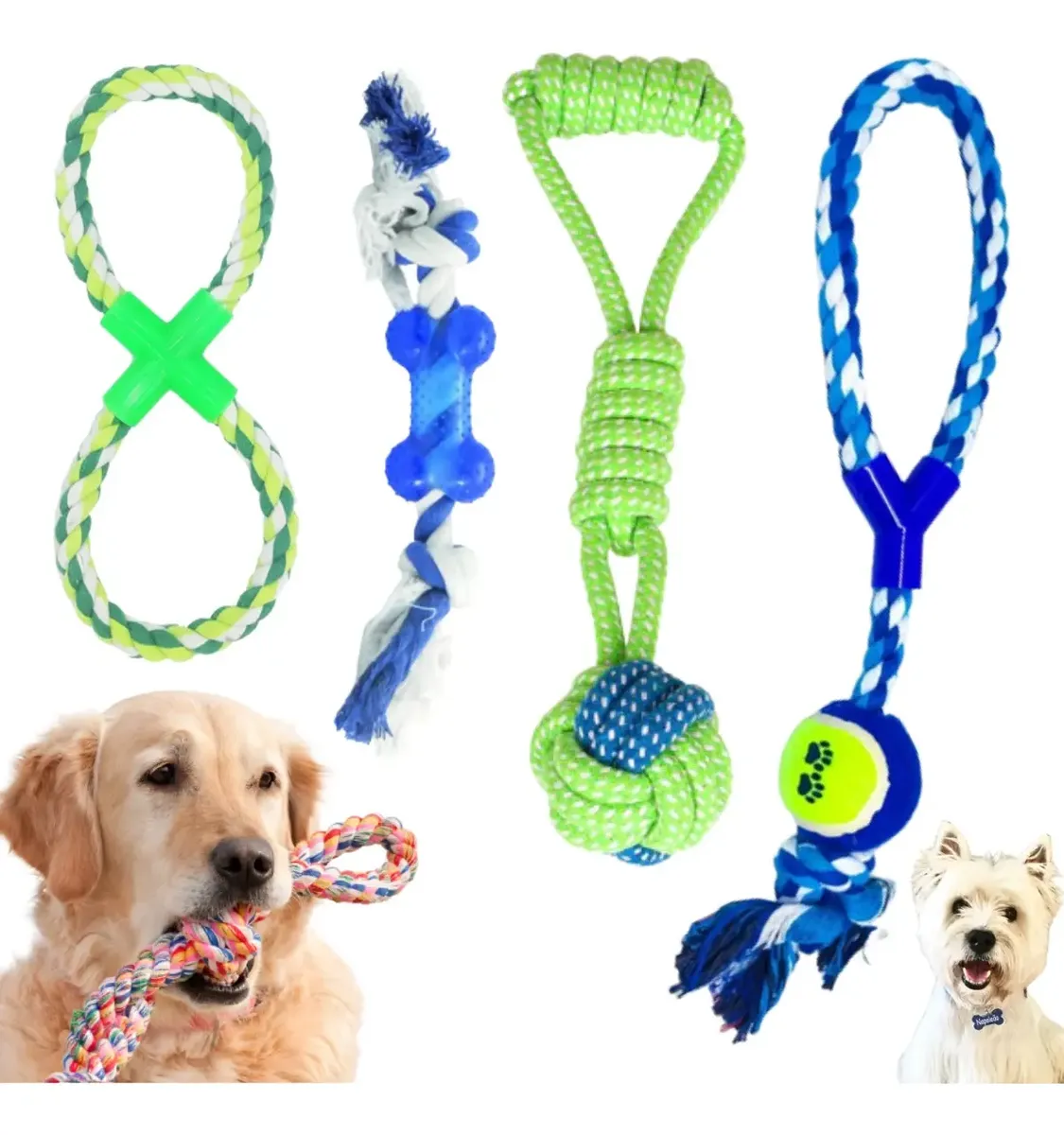
This product is a set of four rope-based toys for dogs, made for biting, pulling, carrying, and interactive play. The kit includes different rope formats, including pieces intended for tug games and ball-style rope play. That variety is important because dogs do not always respond to one single toy shape.
Some dogs prefer a rope with knots because it is easier to grip. Others enjoy a ball-shaped rope because it can be thrown, chased, and carried around. A set with multiple formats gives the owner more flexibility to test what works best without depending on a single toy.
The main appeal is the interactive function. These toys are not only objects for the dog to chew alone; they are more useful when included in short play sessions with the owner. Tug-of-war, light fetch, reward-based training, and chewing redirection are the most natural uses.
The kit is also positioned as suitable for dogs of different breeds and ages. That makes it broadly useful, but it does not mean every piece will fit every dog equally well. Size, bite strength, play intensity, and supervision still matter.
The biggest buying mistake with rope toys for dogs
The most common mistake is assuming that “resistant” means indestructible. Rope toys can be durable for many dogs, but no rope toy should be treated as impossible to damage. A dog with a very strong bite, obsessive chewing behavior, or a habit of shredding fibers may wear the toy down faster than expected.
This kit is best understood as a resistant interactive set, not as a permanent chew object for unsupervised destruction. That distinction matters. A toy used in controlled tug sessions may last much longer than the same toy left with a dog that spends hours pulling out fibers.
Another point is fit. A toy that is too small for a large dog may not be ideal, while a toy that is too bulky for a small dog may not be attractive. Because this kit includes different shapes, it has a better chance of matching different preferences, but the owner still needs to observe how the dog handles each piece.
For puppies, rope toys can be useful during the teething phase because they offer texture and a place to bite. Still, puppy use should be gentle and supervised. If the rope starts to fray heavily or pieces become loose, the toy should be replaced rather than kept in rotation.
Where the kit works best in real life
The strongest benefit is variety. A single toy can become boring quickly, especially for energetic dogs. With four pieces, the owner can rotate the toys across the week, making each play session feel fresher without relying on constant new purchases.
The second benefit is interaction. Tug games can help a dog spend energy, practice impulse control, and build confidence when played correctly. The owner can ask the dog to release, wait, sit, or restart play, turning a simple rope toy into a training tool.
The third benefit is chewing redirection. Dogs often bite inappropriate objects because they are bored, understimulated, teething, or seeking attention. A rope toy gives the dog a more appropriate item to grab, especially when the owner introduces it at the right moment.
The kit can also help with mental stimulation. Chewing, pulling, chasing, and carrying all involve different behaviors. This is useful for dogs that stay indoors for long periods and need more than a short walk to feel satisfied.
- For tug play: the rope formats give the dog and owner something easier to hold during short, controlled sessions.
- For fetch-style play: ball-shaped rope pieces can be more engaging for dogs that like to chase and retrieve.
- For puppies: the texture can help redirect biting during teething, as long as play remains supervised.
- For bored dogs: rotating the four toys can make the routine less repetitive.
What owners should watch before relying on it
This kit may disappoint owners who expect a toy for extreme, unsupervised chewing. A dog that destroys dense rubber, hard nylon, or thick toys may also damage rope toys quickly. In that case, this set can still be useful for supervised play, but it should not be the only chewing solution.
Another care point is fiber ingestion. Rope toys naturally can fray with use. If a dog pulls threads out and tries to swallow them, the toy should be removed. This is not unique to this kit; it is a general safety rule for rope-based dog toys.
Cleaning also matters. Rope toys can collect saliva, dirt, and outdoor residue. If the dog uses them frequently, the owner should inspect and clean them regularly according to the material’s tolerance. A toy that looks dirty, smells bad, or has loose parts should not stay in daily use.
The product also does not replace exercise, training, or environmental enrichment. It can support those areas, but it cannot solve behavioral issues alone. Dogs with intense anxiety, destructive habits, or compulsive chewing may need a broader routine and, in some cases, professional guidance.
Performance, resistance, and play experience
The kit’s practical performance depends heavily on the dog’s bite style. Dogs that like to tug, carry, and chew moderately are the best match. They can enjoy the rope texture and the different shapes without immediately destroying the toys.
For strong dogs, the word “resistant” should be interpreted carefully. The toys are presented as suitable for firm play, but the safest use is supervised interaction. This is especially important during tug-of-war, because dogs can become excited and intensify the bite.
The four-piece format gives the set a useful advantage over one-piece toys. If one shape does not interest the dog, another may work better. A rope ball may be more attractive for chase games, while a longer rope or puller-style piece may be better for tug sessions.
The kit is also useful for owners who want to test their dog’s toy preference. Some dogs are not motivated by plush toys. Others lose interest in hard chew toys. Rope toys sit between these categories because they are flexible, textured, and easy to use in interactive games.
In terms of comfort for the owner, rope toys are usually easy to grip during play. That matters because a toy that is difficult to hold can make tug games less controlled. The more controlled the play, the easier it is to teach release commands and avoid overly rough behavior.
The type of dog that can enjoy this set most
This kit makes the most sense for dogs that enjoy interactive play with their owner. If the dog likes tug-of-war, chasing toys, carrying objects around, or chewing textured items, the set has a good chance of being used regularly.
It is also suitable for families that want more than one toy available at home. One piece can stay near the living area, another can be used in the yard, and another can be kept for training moments. Rotating the toys can help reduce boredom.
Puppies may benefit from the chewing texture, especially when they are trying to bite everything around them. For this use, supervision is essential. The goal is not to let the puppy destroy the rope, but to guide biting toward a proper object.
Adult dogs with moderate energy can also benefit from the kit. A short tug session can be more engaging than simply throwing a toy once or twice. For owners who want to strengthen the bond with the dog, this interactive element is one of the strongest points.
When another toy may be a smarter choice
This kit is not the best match for dogs that need a heavy-duty chew solution above everything else. If the dog destroys rope quickly or swallows loose fibers, a tougher material designed specifically for power chewers may be safer.
It may also be less useful for dogs that do not like tug games or textured toys. Some dogs prefer squeaky toys, plush toys, treat dispensers, or rubber balls. In those cases, the owner may still test the kit, but expectations should be realistic.
Owners who want a toy for long periods of unsupervised use should also be cautious. Rope toys are better when inspected often and used with attention. They can be part of independent play, but they should not be ignored once they show signs of damage.
For very small dogs, some pieces may feel too large depending on the dog’s mouth and confidence. For very large dogs, some pieces may feel less challenging. This is why observing the first play sessions is more important than relying only on the product name.
How it compares with other dog toy options
Compared with a single rope toy, this kit offers better variety. That is useful because dogs can lose interest when the same toy appears every day. With four pieces, the owner can change the play format and keep the routine more engaging.
Compared with plush toys, rope toys are usually better for tugging and chewing redirection. Plush toys can be comforting and fun, but many dogs tear them open quickly. Rope toys are more appropriate for pulling games, although they still require inspection.
Compared with rubber chew toys, this kit is more interactive and flexible. Rubber toys may be better for dogs that need a tougher chewing object, especially if they are aggressive chewers. Rope toys, however, usually create more opportunities for owner-led play.
Compared with treat-dispensing toys, the rope kit is less focused on food motivation and more focused on physical interaction. That can be an advantage for dogs that need movement, but a treat toy may be better for slow feeding or longer mental challenges.
The best choice depends on the dog’s behavior. If the goal is bonding, tug play, and daily stimulation, this kit is more interesting than many simple chew objects. If the goal is maximum durability for a destructive chewer, a stronger dedicated chew toy may be more appropriate.
A clear buying decision for this rope toy bundle
The 4-piece dog rope toy kit is a practical option for owners who want a simple, versatile, and interactive set. It is especially attractive when the dog enjoys pulling, biting, chasing, and playing directly with people.
Its biggest strength is not one single technical feature. The real advantage is the combination of multiple rope formats in one bundle. This makes the kit more adaptable to different play styles and gives the owner more ways to keep the dog engaged.
The main caution is durability expectation. It can work well for many dogs, but it should not be treated as indestructible. Supervision, regular inspection, and timely replacement are part of responsible use.
For small to medium dogs, puppies, and moderately strong adult dogs, the kit has a strong everyday-use appeal. For extreme chewers, it is better seen as a supervised play set rather than a long-lasting chewing solution.
Is the 4-piece dog rope toy kit good for strong chewers?
Yes, it can work for dogs with a firm bite, but it is not ideal for extreme chewers that destroy toys quickly. The safest use is supervised tugging, chasing, and chewing redirection. If the dog starts pulling fibers out or swallowing pieces, the toy should be removed and replaced.
Can puppies use this rope toy set?
Yes, puppies can use rope toys when the size and texture are appropriate for their mouth. The kit may help redirect teething behavior away from furniture and shoes. Play should be gentle, supervised, and stopped if the puppy starts tearing or ingesting loose rope fibers.
Does this kit help reduce boredom and stress?
Yes, it can help reduce boredom when included in an active routine. Rope toys encourage biting, pulling, chasing, and interaction with the owner. They are most effective when rotated and used in short play sessions rather than simply left on the floor all day.
Is this dog rope toy set safe for unsupervised play?
No, it is better used with supervision, especially for dogs that chew intensely. Rope toys can fray over time, and loose fibers should not be swallowed. Owners should inspect each piece regularly and remove any toy that shows heavy wear, damage, or detached parts.
What kind of play is best with this kit?
Tug-of-war, fetch-style games, chewing redirection, and reward-based training are the best uses. The different rope shapes allow varied play sessions, which can keep the dog more engaged. Controlled tug games are especially useful for teaching release commands and improving owner-dog interaction.
Is this kit better than buying one rope toy?
Yes, for many owners, the kit is more useful than a single rope toy because it gives the dog different shapes and play options. If one toy does not attract attention, another may work better. The variety also helps rotate toys and reduce routine boredom.
Can rope toys clean a dog’s teeth?
Yes, rope texture may help with light mechanical rubbing during chewing, but it should not replace dental care. The effect depends on how the dog chews and how often the toy is used. Brushing, veterinary checks, and proper dental products remain more reliable for oral health.
Who should avoid this rope toy bundle?
Owners of dogs that swallow fibers, destroy toys aggressively, or need a heavy-duty chew object should be cautious. The kit is better for supervised interaction than for destructive solo chewing. If the dog has a history of ingesting toy pieces, a different material may be safer.
The 4-piece dog rope toy kit is worth considering when the goal is to add more interaction, variety, and energy-burning play to a dog’s routine. It is simple, practical, and easy to understand: four rope toys, multiple play possibilities, and a clear focus on tugging, chewing, and bonding.
It is strongest for owners who will actually play with the dog, not just hand over the toys and forget them. Used with attention, the set can support better behavior, reduce boredom, and make daily play more structured.
The best decision is to match expectations with the dog’s bite style. For moderate chewers and interactive dogs, it can be a very useful bundle. For extreme destroyers, it should be treated as supervised entertainment, not as a permanent chew solution.